Showing posts with label Economics. Show all posts

Tuesday, December 6, 2016

St. Nicholas and Using Money in a Catholic Way

First,  a most happy and blessed feast of St. Nicholas to you, dear reader!

I was thinking early this morning as I set up our St. Nicholas display that he really gave us a good example of investing money.  If you are unfamiliar with the story, he secretly gave a bag of gold from his inheritance as dowry for each of three poor maiden sisters so that they could marry well.

I use the term investing rather than giving because if you think about it, there is nothing more important to a healthy civilization than establishing good Catholic communities.  And that begins with Catholic families.  Helping these girls marry was a wonderful way of investing that paid interest by furthering Christ's kingdom, which as a bishop he understood perfectly.

Notice he didn't toss them gold so that they could buy a house of their own or go to college or travel the world.  He gave it expressly for marriage.

He imagined the kind of world in which he wanted to live, one where Christ is King, and he put his money where it would work toward that vision.  And though this example involved charity, I want to engage in the same kind of thought process for all our family's monetary transactions.

However, going from the thought process to the reality is where it becomes exceedingly difficult, dare I say impossible?  As you have probably discovered, there is this whole corrupt underworld operating out of sight that does not care about you, your children, or your grandchildren and actually hates Jesus Christ.  It just wants your money.  It doesn't care whether your neighborhood is safe or whether you have access to food that is not poison.   It's like we live in a giant charade.  I truly feel like I go out into the world with sword drawn just to go to the grocery store and the drug store.  I mean, they look like nice places, but they both really, really want to give me a flu shot!  At least that is what I infer from all the signs they post, trying to entice me to get one.

For our wrestling is not against flesh and blood; but against principalities and power, against the rulers of the world of this darkness, against the spirits of wickedness in the high places.

Clearly, Prince of Lies, Inc., is the real owner of many profitable companies.

So it is difficult, but it really does matter where you bank and what companies you support by buying their products.  We can't give up.  

I have subscribed to two different investment advice/education sites over the years, hoping to find help in this matter, but in both cases I unsubscribed after determining their advice didn't fit my vision.  In fact, it clashed with it.  I don't want to invest in the military-industrial complex even if it is the best return on my money.  It's evil.

Recently I subscribed to another site after watching several video interviews with its author, Catherine Austin Fitts.  Here's one of the first one I watched:


Her site, Solari.com, is such a wealth of helpful information that I am still mining its rich archive two months later.  I subscribed on the monthly plan to see whether I would like it.  It's $30 a month.  I will most likely buy an annual membership in January.  No, I don't get any money from mentioning the site, no benefits of any kind.

I am particularly excited about her posts on "Reviving a Local Economy".  I think it would be a fantastic tool for young Catholic families to use to start creating the kind of place they want to live and raise families.  She gives advice on how to extricate yourself from the corruption as much as possible and how to start investment groups to help one another succeed.  Of course, it is not perfect. It is just the most helpful site I have found so far.  It's so helpful that I could keep writing about it for a long time, but alas, the day wanes, and soon St. Nicholas Day will be over.

So that's all for now.


Thursday, November 24, 2016

Play Me

While walking down the sidewalk, enjoying a festival in an economically-depressed small town, I came upon the scene in the photo to the left.

I stood there mesmerized while the little girl plunked away at the tired keys.  She obviously had never had a piano lesson, but that did not dampen her enjoyment at all.  It probably heightened it.

I was struck with the idea--so simple--that We Can Do Little Things That Make a Big Difference.

There is the possibility that the opportunity to play this piano will lead to an interest in studying music.  This would undeniably be a great return on the investment of making the piano available to festival goers.  But even if no one was inspired to learn music, what a fabulous expression of goodwill!  I believe that such acts create good returns, even if they appear to be invisible.


Recently I noticed an old and scarred baby grand piano on display in my local community center.  It was roped off, but there was a small placard on it that explained that the instrument had been used to teach piano lessons to local children for 30 years.  I marveled at the remarkable impact this piano most likely has had on our town, probably with immeasurable ripple effects of goodness that have echoed throughout the country.  I am grateful to whomever had the insight to put it on display.  So often we are encouraged to publicly admire the big industrialist.  His impact can be measured in dollars, so he easily gains recognition.

I struggle to remember these lessons.  I have gotten caught up in all the national election hoopla.  Yes, the president of the United States is important.  But we cannot discount the importance of the little local things that we can do.  Locally, we can have a far bigger impact than nationally.  

I have been reminded since the election that even a smile matters.  With all the news about the animosity of different groups, I realized that I was beginning to expect people to be unfriendly to me.  I have been enormously relieved to have my expectations proved completely unfounded.  Representatives of the different groups have gone out of their way to greet me with warm smiles and welcoming eyes--to politely and cheerfully say, "Excuse me," as they pass by me in the grocery store.

I happily return the greeting and remind myself to take a break from the news, even the alternative news, and to make decisions on my own experience.


Saturday, February 13, 2016

First and Foremost, a Wife and Mother

Queen Elisabeth of Belgium exemplified the kind of femininity that I admire.

I read about her life on The Cross of Laeken blog and loved the description of how she expressed her affection for her future husband in her letters to him.  This bubbly romance was not reflective of a superficial love.  It was the expression of a fierce love and admiration for him, that continued to grow in their married life.  It is beautifully symbolized by her anger at discovering after his accidental death from a mountain climbing accident, that others had prepared his bruised, broken, and muddy body for burial.  She wanted to render him this last loving service of devotion herself.

I needed Queen Elisabeth's inspiration, as I found myself in somewhat of an identity crisis after I received advice from a finance guru that I should re-enter the work force.   He believes that it's ridiculous for a woman to stay home in "retirement" after her children are grown.

Although I bristled at his use of the word "ridiculous",  I could understand his viewpoint.  I know lots of women do go to work when the children are grown.   In fact, I became painfully aware early in my mothering career that every little milepost in my children's lives was an opportunity, in many people's eyes, for me to go back to work.  But now, apparently, I have no excuse to allow me to stay home and devote my full energy to my career as housewife.

So I spent several weeks considering leaving hearth and home and plunging into the "real world" where what I did every day could be duly categorized and measured in terms of dollars, income taxes, and contributions to the Social Insecurity system.  I realized it would indeed be pleasant to be approved of as a faithful member of the Church of Commerce.  Plus, there are many things that interest me, and it would be great to have the extra income.  I would probably make much better use of my time than I do now.  The discipline would definitely be good for me.

But seriously, the real question for me was not about the value of my returning to the workforce.  It was whether I would be of less value if I chose to continue at home.  Right away I could see a paradigm problem.  I think of myself as a domestic goddess.  Haha!   Wouldn't that term throw the Department of Labor into a tailspin?  I'm sure they just classify me as "jobless" in their grand economy of the gross domestic product, which of course has nothing to do with domesticity.    After many hours of considering what I "produce" in my economy, I concluded that even though I am not changing diapers or homeschooling or ferrying children to piano lessons or baseball practice anymore, I still have a distinct role to play at home.  Just like with all the other stages of my career as a wife and mother, there is a demand for my services.  And I dearly love providing them!

I still research issues in order to offer guidance for the matters upon which my children consult me.  Other times they just want my presence, like the time my then 21-year-old son asked me to accompany him to look at a car he was considering for purchase.  This was on a weekday, during hours that I would have been at work if I had had a job.  He handled the whole meeting with the seller while I stood in the background and marveled at how courteous, confident, and knowledgable he was.  I went with him on the test drive, and he talked to me about his observations of the car's condition and performance.  On the way home we took the scenic route through an attractive neighborhood, and we talked about investing in rental houses.  Later he compared the car he test drove to his Mustang.  He concluded he would rather keep the Mustang.  I don't know how to quantify this two-hour experience with my son for someone who thinks of me as retired.  I can only say that when we got home, I was conscious that we had shared something incredibly important for both of us, and it had nothing to do with cars.

Then there are my parents.  I am free, on short notice, to take them to the doctor and be not only the chauffeur but the second set of ears to listen to what the doctor says and help my parents make decisions on follow-up care.  Right now I am providing all their daily care, but even when they had a hired aide, I still took them to the doctor, stayed with them in the hospital, did their grocery shopping, managed their home maintenance, etc.

My husband, too, can count on me to care for his needs and make home a pleasant place, a refuge for him to return to from his battles in the world.  He is the only boss I have, and the benefits package he offers includes loving me unconditionally.  I love making him happy, and I look forward to being able to devote more time to this project at this new stage in our marriage.

And guess what.  When I asked him if he would like me to return to work, he said promptly and firmly, "No."

So I'll keep on at home and maybe get a framed picture of Queen Elisabeth of Belgium to hang in my living room over the fireplace.


Wednesday, October 21, 2015

Women Waiting for Marriage: It's Hard to Know What to Do

So I heard recently about an eligible bachelor with a high income and a stable job history, a young man who is intelligent and amiable and wants to marry but with this one twist:  he seeks a bride who earns a high income as well.  He is not Catholic but still I was surprised.  Is this a thing?  Am I that out of touch with the modern world?

I checked in with my husband.

"Honey, did you ever consider how much money your future wife would make as part of the criteria for finding the right one?"

His face contorted.

"What?" he asked, as if I had just asked him if he had ever considered marrying a Martian.

"No," he answered definitively.

I explained why I was asking, and he too was surprised.  "I never heard of that," he replied, shaking his head in disbelief.  He didn't say it, but I could tell he was thinking, "he needs to man up".

The next day I heard about a son-in-law who left his wife every time they had a new baby or made an expensive purchase like a car.  He has a fear of responsibility.  Maybe that's what is at the heart of the problem with the other guy.

I didn't need another reason to appreciate my husband, but these stories did cause exactly that reaction.

I'm not so sheltered that I am unaware that the majority of married households are made up of two wage earners.  It's just the idea of a man who already earns an income that is more than enough to support a wife and family comfortably, screening potential spouses based on income-producing ability, never occurred to me.   What a complete inversion of the traditional household economy!

The traditional Catholic world is steeped in its own controversies regarding women and careers.  I know plenty of trads who vehemently disagree with the idea of a woman attending college.  They are mostly single young men, insisting that women should stay home and learn domestic skills until marriage.  I also know others, mostly worried parents, who insist that women need to prepare to support themselves for life, to not expect that they will ever find anyone to marry.   I know wonderful, pious young ladies in both situations.  I spoke with a lovely young Catholic woman recently who told me that her traditional Catholic parents had witnessed so much divorce within their own Catholic families, that they advised their girls, growing up in the 1980s-90s, to become self-sufficient and not to become attached to the idea of marrying.

Me?  I think college today is grossly overrated as a means to a career, and I dislike it in general because it is so flagrantly anti-Catholic and ridiculously expensive.  I would prefer women find other ways to support themselves.  I know that not every home situation is ideal for a woman to remain in until marriage and that it is often the case that she has already learned all that she needs to know about keeping house.  I do think that something is lost when a woman becomes financially independent that will make it more of a struggle to let her husband lead the household if and when she is able to marry.  I also think that her husband, knowing that she is capable of earning a good salary, could be tempted to take advantage of this when things get tough, instead of, as my husband says, "manning up" and doing what's necessary to support the family.   Yes, I know that there are situations where the wife works, and she and her husband have worked everything out where it does not cause a strain on the marriage.  I'm just speaking in generalities and with the idea that we're talking about traditional Catholic homes with several/many young children.

Life is full of struggles, isn't it?

What times we live in.

On a lighter note, maybe the answer lies in promoting participation in wife-carrying contests like this one in Houston.  Enjoy!


Friday, October 2, 2015

I'll Take My Stand that Francis is No Friend of the Southern Tradition

This morning I was much perplexed to read an Abbeville Institute post supportively comparing "Pope" Francis' concerns for the environment and the excesses of capitalism, which he voiced to the US Congress, with the values of the traditional South.  I was like, "Um, you know Francis praised Abraham Lincoln in that same talk, as quoted by the L. A. Times:

Francis on Lincoln: “This year marks the 150th anniversary of the assassination of President Abraham Lincoln, the guardian of liberty, who labored tirelessly that 'this nation, under God, [might] have a new birth of freedom.' Building a future of freedom requires love of the common good and cooperation in a spirit of subsidiarity and solidarity.”

Oh, yes, Lincoln, that guardian of liberty who suffered so much that Pope Pius IX wove him a crown of thorns.  No, wait!  He wove that crown of thorns for Jefferson Davis, not Lincoln!  And didn't Lincoln winning the war give America a new birth of industrialism and pave the way for the military industrial complex?

Actually, the issue is not whether it is Catholic to be "green", it's what priority to give it in the face of much more pressing topics, such as abortion, gay "marriage", and Catholic "divorce".

Luckily a friend who is visiting Richmond texted me a photo this afternoon of Jeff and Varina Davis' headstone.  Their daughter had it erected with this inscription:

"Whom God hath joined together, let no man put asunder."  
"Lord, keep their memories green."

Talk about getting priorities straight!


Wednesday, June 12, 2013

When Father's Day Was Every Day

I have long been interested in the ways that the Industrial Revolution affected family life and how our society might facilitate the return of the patriarchal family.   To my way of thinking, if you really want to do this, you not only have to bring mothers home, you have to bring fathers home as well, because home loses its importance when its head spends the best part of his day elsewhere.

About six months ago I discovered an article titled "Industrialization and Marriage" by Robin Phillips. 
Its main premise is that industrialization fundamentally changed marriage, and this paved the way for our modern de-functionalized homes and even the feminist movement.

Phillips writes that "prior to 1800, the vast majority of people lived and worked in the same place.  Whatever else a couple's relationship may have involved, they were quite literally in business together.  The home, in turn, was not a place where people 'lived' as a passive activity when they were not doing other things.  Rather the home was a small factory, a bustling hub of productivity."  This is how the wife felt part of something important, and she could truly fulfill her role as helpmeet.  I know that I feel  peaceful and am much more focused on what I need to do when my husband is home the whole day.

This idea of the husband and wife being in business together prior to the Industrial Revolution made me think of how we now have "bedroom communities", "media rooms".  Keeping rooms were a mainstay of Colonial houses because inhabitants lived and worked in them.  Keeping implies activity, as in keeping house.  

Here's the part of the article that really stopped me and made me think:  "The geographical proximity of home and work had an impact on how couples thought of their relationship to each other.  A man and wife did not think of their relationship as something that could be abstracted from their mundane life together in the world." He explained that marital relations and earning a living "were closely bound together, and both were situated within an ecosystem of obligations, responsibilities, priorities and expectations that were bigger than the couple's relationship.  Because marriage was understood to be bigger than the relationship itself, this helped to anchor marriage in a narrative external to the two participates (sic)."

Of course this "in business together" relationship extended to the children as well.  I am listening to an audio book on rhetoric by Professor Michael Drout.  He says that in Sanskrit, the word for daughter means "one who milks the cow".  The professor says that it is believed that Sanskrit and Greek and Latin sprung from a common language, so you can see how deeply-embedded these home-supporting roles were in our culture before Capitalism came along.

 I was stunned to learn about the role government played in promoting modern housing.  Silly me, I thought people just got tired of farm life and wanted to move to the suburbs, but no, the "Industrialization and Marriage" article reveals that "the concept of the family room originated from guidelines that the government issued in the middle of the 20th century when specifying how homes could qualify for insurance.  A new model of the home emerged which deliberately detached it from labor and functionality.  Government planners urged architects and home-owners to get rid of walls and doors, to eliminate various work rooms like the sewing room and the pantry and to focus the house instead around the type of domestic bonding that was supposed to occur in rooms like the family room."

Gee, this sounds like what happened to architecture in the Catholic Church after Vatican II.  The functionality of divine worship that was expressed by things like altar rails was destroyed in order to promote "community".

In the case of housing, this change was necessary to convert independent producers into dependent consumers of industrial goods.  It has taken a long time to accomplish, but we are there.  State governments implemented compulsory schooling to speed this along.  I imagine that once dad was gone from home, taking the children was a lot easier, especially as classical education was swept aside and replaced with the memorize-and-regurgitate-textbooks method.

Clearly we have been duped into destroying God's plan for the family.  If only we could see it.

Saturday, August 25, 2012

Chicks and Schemes Hatched


Yesterday we discovered that five chicks had hatched.  Apparently they had hatched a couple of days previously, but I never heard or saw any signs.  So one of them expired shortly after we found them.  Big lesson learned.  Go ahead and put chick food and water out when you don't know how long the eggs have been incubated.  It's good to be back in the chick business.

Emma and I are reading a lot about the financial crisis and are trying to guess what the most likely scenario will be after the collapse.   It's hard to know what to do.  I see a lot of people are emphasizing vegetable gardens.  I am not so concerned with vegetables as I am with having grassfed meat, eggs, and milk because they are densely nutritious, and the body can easily assimilate the nutrients, which is not always the case with vegetables.   Plus you need high quality protein to make neurotransmitters, and you need animal fat for satiety and to make sex hormones from cholesterol.  And after living on raw milk exclusively for ten days and feeling great, I just feel that animals are the more important food source to secure a good steady supply of.

What scenario do you envisage after the financial collapse and how are you preparing?

Tuesday, October 19, 2010

Housewife: Less Money, More Happiness


Hat Tip to Throne and Altar for his post with a collection of links to good information on Patriarchy.  One of them, Requiem for Civilization, featured a quote about the effects of women working that I found useful, not for pointing fingers at women who work but for me to be able to defend myself better.   I believe that a woman's education should prepare her to be a good wife and mother, not earn a living.

From THE COMING MATRIARCHY by Nickles and Ashcraft:


The working woman not only prefers a smaller family, but, in fact, fewer have children… Our survey also showed that working women have less successful marriages. A woman who works was five times as likely to have a disrupted marriage as one who did not work….Working wives are more than twice as likely as housewives to have had affairs by the time they reach their late thirties….Researchers have found that the longer a wife is employed, the more both partners think about divorce- an increase of one percentage point for each year of her employment. Things get worse as she earns more money. Vassar economist Shirley Johnson calculated that every $1000 increase in a wife’s earnings increases her chance for divorce by 2 percent…Women wed to less-educated or younger men had marital dissolution rates at least 50% greater than those marrying similarly-educated or older men. Better-educated husbands brought no increased risk to the marriage.

Saturday, May 8, 2010

Eating Well on $68.88 a Week


It can be done! The Associated Press challenged two chefs and a foods editor to make meals for a week on what the average food stamp payment is for a family of four. One went over budget about ten dollars, but the other two were right on it. This means that theoretically, Emma should be able to provide meals on a gasto of $10 a day. I say theoretically because even professionally-trained chefs struggled and said that it took very careful shopping and a willingness to incorporate leftovers. The menus they planned would be so helpful if they had also given all the recipes. Instead, they gave one sample recipe from each chef. (Click the post title to read MSNBC's coverage of this story.)

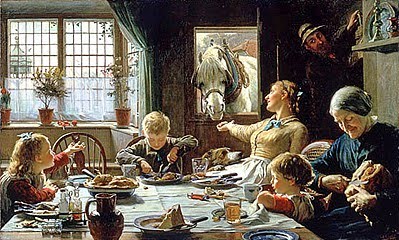
Artwork: One of the Family by Frederick George Cotman
(I wanted to use a larger image, but in all the ones I found, the husband was almost completely obscured in shadow or partially cropped out.)

Sunday, June 21, 2009

Restoring American Textiles

I've been noticing a slow but sure increase in Americans' willingness to pay more for healthier food, whether that is through a co-op, the organic food and produce sections at the grocery store, or buying directly from farmers. It is awfully encouraging to me.

As I sat watching people weave at Upstairs Studio last week, I asked if anyone thought there was hope for restoring the American textile industry. I read that 44 textile plants closed just last year.

We had a long discussion about the unwillingness or inability of the textile companies to pay competitive American wages and benefits, footing the bill for safe working conditions while competing with cheap labor overseas. It would seem that the the American consumer will have to be willing to pay more for American-made products.

Wondering if there is some middle way, somewhere in between homespun and corporate textile companies, I read up on craft guilds in Catholic Encylopedia. Here's the excerpt, titled "Craft guilds" (in England):

"Seeing that the merchant guilds had become identical with the municipality, the craftsmen, ever increasing in numbers, struggled to break down the trading monopoly of the merchant guilds and to win for themselves the right of supervision over their own body. The weavers and fullers were the first crafts to obtain royal recognition of their guilds, and by 1130 they had guilds established in London, Lincoln, and Oxford. Little by little through the next two centuries they broke down the power of the merchant guilds, which received their death-blow by the statute of Edward III which in 1335 allowed foreign merchants to trade freely in England. In the system of craft guilds the administration lay in the hands of wardens, bailiffs, or masters, while for admission a long apprenticeship was necessary. Like the merchant guilds, the craft guilds cared for the interests both spiritual and temporal of their members, providing old age and sick pensions, pensions for widows, and burial funds. The master craftsman was an independent producer, needing little or no capital, and employing journeymen and apprentices who hoped in time to become master craftsmen themselves. Thus there was no "working class" as such, and no conflict between capital and labour. At the end of the reign of Edward III there were in London forty-eight companies, a number which later on rose to sixty."

Does anyone know of such a guild operating today? I know that Harrisville Designs will take your fleece and spin it into yarn for you, and I once bought a wool blanket from a Louisiana farm that sent its raw wool somewhere and had it turned into blankets. These kinds of activities are a step in the right direction, but still a long way from a functioning medieval-type guild. If any one knows of individuals who have organized textile co-ops or have other ideas for restoring small-scale American-made textiles, please comment with the information.

Sunday, March 29, 2009

Mother Hen

Emma has been reading all of the flying magazines that Herb has been getting. Consequently, she has fallen in love with ultralight airplanes and plans to own one as soon as she can. There are only two obstacles: her dad says "no", and she doesn't have the money. She has decided that the best approach is to earn the money first, then patiently present her research to her dad showing that ultralight technology has improved dramatically, and they are now safe. That's the plan anyway. If he still says "no", she'll have a nice nest egg for something else.

My mother has contracted for Emma's weekly maid services. Emma plans to earn the rest of the money by selling eggs, rabbits, and milk if I will finance half the expense of a cow. She also wants to raise Bantam Aracaunas. So at the Laetare Sunday dinner, she traded Mickey a dozen of our eggs for a dozen of his hopefully-fertilized Bantam Aracauna eggs. She dragged out our incubator, cleaned and sterilized it and studied the direction booklet. It was not much help. Actually, it was rather disturbing. It has a long list of things that can go wrong and the causes: mushy chicks, soft chicks, exploders, etc. The editors didn't bother to explain the difference between a mushy chick and a soft chick. Nor did they deem it necessary to tell whether a mushy or soft chick is dead or alive. Details, details.

Temperature is, naturally, one of the critical factors, so Emma has been diligently checking the temperature inside the brooder with two or three different thermometers and doing internet research on embryology. At least once a day she retreats to her "candling" room (our half bath) to check the eggs with a flashlight for signs of life.

In the midst of all her concern for her "babies", Mickey texted me to tell me that one of his hens just hatched eight chicks. Naturally, Emma was a little discouraged that he should reap all of these benefits with so little effort, but he has offered her the mother and the chicks. That smoothed everything over! She'll bring them home today after Mass. . .if she can catch them.

Mickey's birds are wild.

Saturday, February 21, 2009

Big Brother, Can You Spare a Dime?

It gives me a headache reading about the "stimulus": I guess it's from trying to make sense of something that is hopelessly non-sensical. Only the federal government would think it's a good idea to "bail out" bankrupt organizations when the government itself is trillions of dollars in debt.

It's the kind of thinking that Ayn Rand wrote about in Atlas Shrugged and The Fountainhead. Herb has been listening to Atlas Shrugged on his MP-3 player. He and I first read it in the early '80s. He's says it's even more relevant now. Parts of it sound like the evening news.

"Will You Be Able to Retire? An 8-Point Check List" is an article I received today from Gary North. Just a little warning--the answer is probably "no". In fact, you'll probably need to get a second income.

Normally this article would only be available to garynorth.com subscribers. He is opening it to everyone for one week.

Tuesday, December 16, 2008

A Piano in Every Living Room

Our old piano tuner knew the history of many American piano manufacturers: which ones made really good instruments, where they were located, when they went out of business. Sadly, he never told me of a new American piano company being founded. He knew the American piano industry was dying. Because of this, although I always looked forward to his visits, I would come away from them feeling a little sad. It was like the conversations I used to listen to as a child between my elderly relations. They always ended with a discussion of who had died that week.

When I saw an essay by Jeffrey Tucker on the piano industry, I eagerly read it. He explained how Americans used to value pianos:

It was widely believed that spending money on a piano wasn't really spending. It was an investment. The money you paid would be embedded right there in this beautiful and useful item. You can always sell it for more than you paid for it, and this was generally true. So people would make great sacrifices for these instruments.

Americans did not buy pianos just because they were a good investment. Mr. Tucker says:

They were used in classrooms everywhere in times when music education was considered to be the foundation of a good education. They were the concert instruments in homes before recorded music and iPods. They were essential for all entertainment. American buyers couldn't get enough, and private enterprise responded.

This is a really good point that deserves to be repeated: "Music education was considered the foundation of a good education." It is also important to note that while iPods may have replaced the home piano in most American homes, the two are in no way equal. Americans have definitely regressed in the home music department.

I was disappointed to find that Mr. Tucker's point in writing the piece was to prove that the government should not bail out the auto industry:

In the same way, many people will bemoan the loss of the US car industry and wax eloquent on the glory days of the 1957 Chevy or what have you. But we need to deal with the reality that this is in the past. Economics demands forward motion, a conforming to the facts on the ground and a relentless and realistic assessment of the relationship between cost and price, supply and demand. We must learn to love these forces in society because they are the only things that keep rationality alive in the way we use resources. Without them, there would be nothing but waste and chaos, and eventual starvation and death. We simply cannot live outside economic reality.

Of course he is right. I just wish that he had discussed the spiritual reality and how it is the spiritual reality that determines the economic reality.

If the goal is heaven, then are you more likely to get there in a Chevy or by gathering around the family piano and singing the old songs and hymns? Seriously, what would it say about our country if we had a booming demand for American pianos but imported all our cars?

Mr. Tucker's essay is filled with the kind of information that I used to discuss with our piano tuner. It's good. I hope you will read it. Then, ora et labora to change the spiritual reality to one of a Christian culture. And get a piano for heaven's sake!

Saturday, October 4, 2008

Agrarianism, Poetry, and Picture Books

Herrick Kimball from The Deliberate Agrarian writes about Donald Hall, author of The Oxcart Man, a children's picture book that I remember reading to my children. He sees the potential for using this book to teach economics. Cay Gibson, who wrote a book called A Picture Perfect Childhood about using picture books this way, would be proud. Mr. Kimball shares some of Hall's agrarian poetry that he discovered in researching The Oxcart Man and wraps it all up with insightful comments on the good, the true, and the beautiful in the context of poetry.

Friday, May 9, 2008

Rainy Days and Social Security Statements Always Get Me Down

Every five years or so I actually open my official Social Security Statement and read it.

I really appreciate the expert advice, like this whippersnapper: "Saving and investing wisely are important not only for you and your family, but for the entire country." Whoa! Tell it like it is, Big Bro!

It continues: "If you want to learn more about how and why to save, you should visit www.mymoney.gov, a federal government website dedicated to teaching all Americans the basics of financial management." What a comedian! I'm overcome with a paroxysm of gut-wrenching, foot-stomping laughter. I know he can't teach all Americans the basics of financial management because he DOES NOT KNOW the basics of financial management. He is trillions of dollars in debt and always ready to sign our names to another IOU. He's fat. He's jolly. And he's always ready to party. What a hoot!

To keep from cracking myself up entirely and to recover my dignity, I skip over to page 2.

The first part always starts the same, just like a fairy tale: Once upon a time, "you earned 14 credits of work. To get retirement benefits, you need 40 credits of work."

With that encouraging bit of information, I can't wait to move on to the next juicy tidbit, Disability. "To get benefits if you become disabled right now, you need 26 credits of work. Your records show you have at least 14 credits at this time." Gosh, this is looking grim. I don't think I'll have enough credits to graduate. I'll be marked as a Social Security dropout for life. Scanning quickly through the other categories, I see that I do not qualify for benefits any time, any place, not no way, not no how.

Thankfully Big Brother sends me these reports, otherwise I might get the Big Head and forget that I am an underachiever of official Social Security credits. Woe is me. SIGH.

One fine day, I'll open my report, and it will say something new. It will say: "You chose to stay home with your children. Not only that, but you even homeschooled them, saving the government thousands upon thousands of dollars. Big Brother is SOOOOOO proud of you! So proud in fact that Social Security is going to award you an honorary diploma worth 26 credits of work.

Suddenly, I hear the Everly Brothers singing, Dream, dream, dream, dream.

I go back to page 1 and read, "Social Security is a compact between generations." Well, what do you know about that? A compact. Between generations. I picture happy old people in white robes shaking hands with happy young people in overalls. Wow! And I had always thought it was a compulsory tax, collected at the point of a gun. Will wonders never cease!

Uh-oh. A dark cloud appears inside my silver lining as I read: "In 2017 we will begin paying more in benefits than we collect in taxes. Without changes, by 2041 the Social Security Trust Fund will be exhausted. . ."

Hey, I'm already exhausted, but I still do my duty. Anyway, the money has been set aside, right? Basic financial management--the workers pay in, you set it aside. Right?

I fold my report and put it away. I think positive. In five more years. . .oh, no. Images of McCain, Obama, and Polly Esther Clinton loom forbodingly in my imagination. Maybe I'll wait ten years before I look at my Social Security Statement again.