Showing posts with label History. Show all posts

Thursday, September 1, 2022

Good for Your Soul: Jefferson Davis's Remarks on Robert E. Lee


On a whim tonight I decided to check Abbeville Institute's site for something historical to read. I hadn't visited in months, maybe not since last year. I discovered just the right thing to suit me: a speech by Jefferson Davis honoring Robert E. Lee. I didn't read the whole thing. The first two paragraphs were enough. I had a deep need to read about a truly good man. I had been reading Twitter. Enough said? 

This was a double scoop of edification, because Jefferson Davis's own goodness shone brilliantly in his remarks about his friend. Such gentlemen. Shall we have the likes of them again when the rule by the insane predator class is over? ( I started to just say "predator" but felt it was critical for accuracy to go back and add the modifier "insane".)

 I didn't read the whole thing because I have How to Resist Amazon and Why by Danny Caine on the chair beside me. I want to get started on it. And on the other chair I have a gorgeous edition of Kenneth Grahame's The Wind in the Willows, which I started re-reading with supreme delight a couple of nights ago. 

Anyway, here are the two paragraphs I read about the admirable Robert E. Lee:


Robert E. Lee was my associate and friend in the military academy, and we were friends until the hour of his death. We were associates and friends when he was a soldier and I a congressman; and associates and friends when he led the armies of the Confederacy and I presided in its Cabinet. We passed through many sad scenes together, but I cannot remember that there was ever aught but perfect harmony between us. If ever there was difference of opinion it was dissipated by discussion, and harmony was the result. I repeat, we never disagreed, and I may add that I never in my life saw in him the slightest tendency to self-seeking. It was not his to make a record, it was not his to shift blame to other shoulders; but it was his with an eye fixed upon the welfare of his country, never faltering to follow the line of duty to the end. His was the heart that braved every difficulty; his was the mind that wrought victory out of defeat.

He has been charged with “want of dash”. I wish to say that I never knew Lee to falter to attempt anything ever man could dare. An attempt has also been made to throw a cloud upon his character because he left the army of the United States to join in the struggle for the liberty of his State. Without trenching at all upon politics, I deem it my duty to say one word in reference to this charge. Virginian born, descended from a family illustrious in Virginia’s annals, given by Virginia to the service of the United States, he represented her in the Military Academy at West Point. He was not educated by the Federal Government, but by Virginia; for she paid her full share for the support of that institution, and was entitled to demand in return the services of her sons. Entering the army of the United States, he represented Virginia there also, and nobly. On many a hard-fought field Lee was conspicuous, battling for his native State as much as for the Union. He came from Mexico crowned with honors, covered by brevets, and recognized, young as he was, as one of the ablest of his country’s soldiers. And to prove that he was estimated then as such, let me tell you that when Lee was a captain of engineers stationed in Baltimore the Cuban Junta in New York selected him to be their leader in the struggle for the independence of their native country. They were anxious to secure his services, and offered him every temptation that ambition could desire. He thought the matter over, and, I remember, came to Washington to consult me as to what he should do, and when I began to discuss the complications which might arise from his acceptance of the trust he gently rebuked me, saying that this was not the line upon which he wished my advice, the simple question was “Whether it was right or not”. He had been educated by the United States, and felt wrong to accept place in the army of a foreign power. Such was his extreme delicacy, such was the nice sense of honor of the gallant gentleman whose death we deplore. But when Virginia withdrew—the State to whom he owed his first and last allegiance-the same nice sense of honor led him to draw his sword and throw it in the scale for good or evil. Pardon me for this brief defence of my illustrious friend.

Please do read the whole thing here if you have a mind to: Jefferson Davis on Robert E. Lee 

Wednesday, December 7, 2016

To Fast or Not to Fast, That Is the Question

Editor's Note:  Initially this post was inadvertently titled after a rock song.  About an hour after publishing, the lyrics surfaced in my brain, and I thought it better to change the title to the present one.  Happily, it is a more fitting title anyway.

After the gingerbread cookies and the chocolate of St. Nicholas Day, the complete fast of the Vigil of the Immaculate Conception:  2 snacks, 1 full meal, no meat.

And, I might add, no questions.

This past Vigil of All Saints, I realized that my two traditional Catholic calendars contradicted each other on whether to fast.  After consulting a knowledgable friend, I learned that the fast had actually been abrogated under Pope Pius XII.  So you could choose not to fast at all.

Today when I was looking at my calendar from St. Jude Shrine, my sedevacantist parish, I found a page titled "Supplement to the Instructions for Fasting and Abstinence" with all the background information to the changes that occurred under Annibale Bugnini during Pope Pius XII's reign.  Whether or not you agree with the sedevacantist position, the history is good to know.  I wish I had known it back in October.  I wouldn't have been so confused.

The last two paragraphs of the supplement page explain how the traditional fast for the Vigil of the Assumption was "transferred" (effectively abrogated) to the fast for the Vigil of the Immaculate Conception during the latter part of Pius XII's pontificate and how there never was confirmation from the Vatican on whether the obligation to fast on the Vigil of All Saints was to be lifted.

"This brief historical background serves as an introduction to the main purpose of this advisory, namely, to address the questions surrounding the abrogation of the Vigils of All Saints and the Assumption, and the suspension of the fasting and abstinence regulations for those vigils.  Both vigils were abolished in the 1950's, quite possibly as the first phase of 'change for the sake of change', engineered by the aforementioned Masonic infiltrator, Hannibal Bugnini.  When the American Bishops requested an official determination from Rome on whether the custom of fasting and abstinence on the suspended Vigil of All Saints had also been terminated, they received only a pre-printed notice, dated 15 March 1957, stating that, 'The Decree of the Sacred Congregation of Rites...looks simply to the liturgical part of the day and does not touch the obligation of fast and abstinence that are a penitential preparation for the following feast day.'  Thus, without any official confirmation from the Vatican that the disciplines associated with the Vigil of All Saints no longer applied, the US Bishops unilaterally dispensed American Catholics from those long-standing regulations.  In 1957, the power of the still-valid and legitimate American bishops to bind and loose in disciplinary matters pertaining to the faithful under their care was certainly lawful.  However, the bishops' decision to relax the vigil fast was in reaction to the first wave of Vatican innovations that would soon morph into an all-out, anti-Catholic liturgical revolution that was spring-loaded to be unleashed upon the death of Pius XII.

"Just fourteen months before the demise of that aged and ailing pontiff, the penitential custom of fasting and abstinence on the Vigil of the Assumption was also effectively abolished by its transfer to the Vigil of the Immaculate Conception, this time by official decree of the Sacred Congregation of the Council (sic) on 25 July 1957.  This unusual move seemed to contradict the Pope's prohibition against rearranging the liturgical calendar, issued by his encyclical, Mediator Dei, ten years earlier.  Nevertheless, it is beyond the scope of this brief review to provide an analysis of this legislation, or, for that matter, to challenge every alteration in discipline that was enacted during the pontificate of Pius XII.  Indeed, three of them turned out to be providential just a few years later, after the true Mass had been taken away from parish churches.  The exemption of water from the Eucharistic fast in 1953; the shortening of the Eucharistic fast from Midnight to three hours; and the simultaneous introduction of Sunday Evening Masses in 1957, made it possible for circuit-riding, Latin Mass clergy to bring valid Sacraments to remote groups of remnant faithful on Sunday nights, sometimes hundreds of miles away, after assisting their own congregations earlier in the day.  Thus the legislative revisions in the waning years of Pope Pius XII may be viewed as a 'mixed blessing', with some seemingly inspired by the Holy Ghost and others of doubtful origin.  In any case, there can be no imputation of sin to those who no longer observe the old rules for fasting and abstinence on the Vigils of All Saints and the Assumption.  The faithful who are able to continue those traditions (while retaining the practice also on the Vigil of the Immaculate Conception) are encouraged to do so, as voluntary acts of penance win greater spiritual merit than those done purely for compliance with the law.  Finally, the rules for fasting and abstinence on the Vigils of Pentecost and Christmas were not affected by the changes in question, and therefore, are still listed as obligatory by this calendar."

Saturday, November 26, 2016

The Logic of Secession

From Trump Wins--Secession Back in Style by James Ronald Kennedy
"The idea that a large and supreme central government in the United States can protect the rights and interests of all the people is mathematically absurd. When the original federal government under the constitution was established (1789) each member of the House of Representatives represented the interests of 60,000 citizens. Today each member of the House of Representatives is supposed to represent the interests of over 700,000 diverse people. If we had the same ratio today, there would be over 5,000 members of the House of Representatives! It is absurd to think that a supreme central government that rules over the lives of over 300 million people would be able to protect the interests of the political minority. Under the current system of supreme federalism, the lives of 300 million people are governed by a majority vote of 269 members of Congress and even less if acting by a mere quorum. With Trump’s victory, even liberals, who once controlled the federal government, are now beginning to see the logic of secession."


Monday, November 21, 2016

What I Noticed in the Toy Kitchen Ad


I was flipping through a Costco catalog recently and came across the toy kitchen ad above.  It struck me as odd, and I spent some time studying it to see if I could figure out why it gave me that impression.  I decided the main thing that puzzled me is that the children seem so detached from any involvement with the kitchen.  The girl especially seems to simply be passing by.  She steadies herself by holding the countertop.  She is equipped with a cell phone.  Perhaps she is going to order a pizza and re-heat it in the microwave? The boy appears to be holding on to the back of the refrigerator with his right hand while he half-heartedly reaches for the handle of the refrigerator.   Both children may need to hold on to something because, if you notice their feet, they each have one foot turned on its side.  It's not a stance that lends itself to taking action.   It seems really odd to me that both children have their feet placed this way.

An alternative explanation of the detachment from activity is that the photographer needed the children out of the way to be able to showcase the kitchen.  However, this could have been overcome by showing the girl putting something in the sink and showing the boy in the act of filling a glass from the water dispenser in the refrigerator door--or many other options.

I decided to look at vintage ads for toy kitchens to see what I could learn by comparison.  I chose to study the one below.


Of course the pink appliances are noticeably different from the first picture and imply that the kitchen is the girl's/woman's domain, but the main thing I notice that is different from the modern ad is that each unit is open, implying active participation.  I can't tell if the girl's hand is actually touching the refrigerator handle, but the door is open, and she is holding something in her other hand--maybe a plate--definitely something to do with kitchen play.  She is clearly happily involved in her pretend world.   And look at her feet.  Both are flat on the floor.  I notice that she doesn't lean on anything.  After looking at her and seeing how upright she is, I recalled how good posture used to be emphasized to children.  I even remember being instructed in proper sitting posture in first grade in 1966, which included both feet being firmly planted on the ground.

With this insight, I went back and looked again at the children above with their turned feet.   I think the modern girl looks more confident than the modern boy.  She gets the more upscale outfit and shoes; he gets the sneakers and jeans.  The oversized untucked shirt gives him a soft look overall.  

Looking back at the pink kitchen, I notice the emphasis of time.  See the big clock above the stove?  This girl is going to get meals cooked on time.  She is productive.  I don't get that impression from the modern children.  

Maybe "hanging out" is the new play.

Wednesday, May 25, 2016

The Modest Motorcycle Mama Goes Cross Country, Part 1

In Grand Teton National Park, Wyoming

5,266 miles in 17 days, averaging 310 miles a day!

As far north as Glacier National Park in Montana and as far west as the Pacific coast.

In a skirt the whole time, except for one afternoon when it was storming, and I had to put on a rain suit.

I wore long, full skirts with tights underneath.  It was no problem at all!   I found that the best way to get on the bike was to sit down sidesaddle and swing my right leg over.  This I could do easily while maintaining modesty.  Apparently, my attire did elicit some attention.  Two or three times on our trip, my husband told me via our intercom, "Those ladies like your skirt," as their car passed us.  Each time I asked him how he knew that.  Each time he said that he was sure because they were looking and pointing and smiling.  I'll take his word for it.  In any case, he was really happy and proud, which made me feel fantastic.

Our first full day on the road,  we started with breakfast on a rock in the HEB grocery store parking lot.   So romantic!  I think we were just north of Waco.  We had our own little patch of grass and a wonderful assortment of delectables to savor, including guacamole.  I discovered that I really like guacamole and bananas and coffee for breakfast.


We made our first big stop in Vernon, Texas.  Herb indulged my longing to tour this little museum there.  It proved quite interesting, as it was all about the history of the area and how it was settled by these big ranchers, like W.T. Waggoner.  A giant section of the museum was devoted to scads of exotic hunting trophies bagged by a local man, William A. Bond.  


I really was not expecting to see this in sleepy little Vernon.

The explanation of what happened to our country after the War of Northern Aggression and also the insight into the cattle barons' philosophy (below) was worth the price of admission.  Nothing Catholic here, folks.


One thing I didn't take into account when preparing for our trip:

At the end of the first day, I discover I am a Redneck.

Thursday, April 28, 2016

Forget the Election and Celebrate Catholic Thanksgiving

From the movie "Babette's Feast"


Editor's Note: I got the idea and the historical background for this post from reading Dr. Marian Horvat's "The First Thanksgivings Were Catholic."

If you, like I, really detest the whole Puritan/Pilgrim party that is foisted on us every November, right when Catholics should be preparing for Advent and Christmas, your chance to fight back with a holiday that is truly meaningful is coming up: Saturday, April 30.  That's the day the second Thanksgiving was celebrated, in Texas, with Holy Mass and a great feast.  Even better, according to "The First Thanksgivings Were Catholic," after the Mass, the expedition leader, "Don Juan de Oñate, took formal possession of the new land, called New Mexico, in the name of the Heavenly Lord, God Almighty, and the earthly lord King Philip II."

Now that's more like it! 

May Catholic men rise up in the spirit of Don Juan de Oñate and renew the effort that Catholic missionaries began so valiantly long ago, establishing outposts of the True Faith in the midst of our  pagan land.  Why waste time worrying over which narcissist will be the next president of the United States?  It's just another distraction at this point.  Plus, should Catholics aspire to getting back to America's Masonic roots and its godless Constitution as "conservatives" propose?

No, we must build from a solid foundation; we must establish a Catholic order, replacing Lady Liberty with Our Lady of Guadalupe, and it is not going to happen with anyone who is "electable" in the present system.  


The first priority is establishing the Social Reign of Christ the King in our homes and in our communities.  That will provide the rich soil from which the seeds of good government may burst forth and flower.  Catholic mothers, with Rosary in hand, must form Catholic citizens.   And it can start with simple things like celebrating Catholic Thanksgiving on April 30 and again on September 8, the day on which we celebrate the Nativity of the Blessed Virgin Mary in a month rich with Marian feasts, when the real first American Thanksgiving was celebrated in Florida by Spanish Catholics.

And by all means invite your non-Catholic friends.

I highly recommend watching Babette's Feast.  It seems the perfect artistic representation of the difference between celebrating Protestant Thanksgiving and Catholic Thanksgiving, and not only that, it is a truly beautiful movie that will uplift and inspire you and increase your sensus Catholicus.


Wednesday, April 27, 2016

In the Spirit of Fraternal Encouragement: A Music Detox


John Cuddeback, a philosophy professor at Christendom College, has invited his Bacon From Acorns blog readers to join him in listening to only a select few "classical" music pieces for two weeks.   I think it is a grand idea!  It offers a reset of our emotions and an opportunity to get to know several beautiful pieces intimately.  Read his post linked above to get his list of recommended pieces, overflowing with musical antioxidants.

Mr. Cuddeback does not include any Gregorian chant because of its intended use as liturgical prayer, but here I must lovingly disagree.   Are we not to pray without ceasing?  And is not the home our domestic church?  I think it would add greatly to the efficaciousness of the "fast" to listen to one piece of chant every day for the two weeks, especially if you did it first thing in the morning to help set the tone for the rest of your day.  Aside from the graces to be gained,  it would also give our parasympathetic nervous systems, so overloaded with the stimuli of modern culture, a rest, as Gregorian chant appeals directly to the intellect, not the passions.

Need more inspiration?  Here are two things I read today that I found immensely edifying.

Twelve Latin Chants Every Catholic Should Know:  This is great for narrowing down the choices, and it gives a little background with each chant.  Well, actually I lied.  It didn't help me narrow the choices.  With each description I was sure that I would finally decide on THAT piece, only to read the next description and decide that it was THE ONE.  Maybe I shall start at the top of the list and listen to each piece for two weeks until I have absorbed each one into my being.

Feeding Our Children Liturgical Garbage:  Jeff Ostrowski, who holds a Bachelor's degree in Music Theory, explains in a short Views from the Choir Loft blog post why we should listen to the best music and provide it for our children.  He shares some stellar quotes, too.

Friday, April 8, 2016

We're Totally PC


Update:  I added a favorite Civil War song at the end of this post.

Panna Cotta forever!  I don't care if I ever eat another dairy-based pudding.  Emma's been making double batches of this delectable coconut milk pudding, using Deliciously Organic's recipe.   Talk about good and good for you!  It features grass-fed beef gelatin powder--we use Great Lakes brand--which is a wonderful source of amino acids.  This panna cotta is really creamy and dense.  I keep telling Emma we need to try it as a topping on this chocolate tart she makes.  Considering how much time I have spent imagining how delicious this combination would be, it's probably best we don't do it.

 The lovely color combination of the fruit on the creamy white pudding inspired me to use some of our recently re-discovered stash of awesome Confederate flag decorations.  Emma and I were so excited when I pulled them out from behind some cookbooks!  We started naming all the ways that we could make use of them, ending with Emma's suggestion of wedding cake.  Oh, yes, she is a Southern girl!  No, we don't believe in slavery, not even the wage slavery that was supported and spread by the North.  We do love the agrarian lifestyle of the Old South and that was more in line with the Catholic ideal.  Plus, we have ancestors who fought in that War of Northern Aggression, so it's wonderful to be able to honor them.

Here's a beautiful rendition of The Homespun Dress (O Yes, I am a Southern Girl)


Wednesday, March 16, 2016

Striving to Be Catholic in the Land of the Green Dragon

One can be a citizen of the USA (that is, CUSA) and be a Catholic, and most CUSAs are Americans. One cannot be a Catholic and an American. To be an American is to believe in American principles before the teachings of the Church, or in other words to accept the Enlightenment ideals as superior to the teachings of the Faith.  ~ David Wemhoff, "Joseph Ratzinger's American Mind"

Although I do not agree with Mr. Wemhoff's contention in the full article that the Conciliar church has not changed doctrine, I heartily agree with this quote.  It sums up all that I have figured out in my studies over the last few years.  Listening to two of Wemhoff's interviews on how Americanism was purposely inserted directly into the circulatory system of the Church, finally helped me see how John Courtney Murray, an American Jesuit priest and "theologian", was able to get Religious Liberty approved at Vatican II, an idea that had always been condemned by the Church.  The interviews are based on Wemhoff's book, John Courtney Murray, Time-Life, and the American Proposition.  I haven't read the book, but the Amazon description of it is helpful background for listening to the interviews.  Here's a portion of it:
In 1941, Franklin D. Roosevelt gave his famous "Four Freedoms" speech. In that speech, FDR set forth a vision for the reengineering of societies around the globe. The means was psychological warfare, involving the manipulation of ideas, words and symbols to divide target societies and convince these societies of the ideology that formed America. The most important society America targeted was the Roman Catholic Church. Media mogul Henry R. Luce, founder and publisher of enormously influential magazines like Time and Life, used the CIA's doctrinal warfare program to turn the Catholic Church into a promoter of American ideas. This struggle reached its culmination at the Second Vatican Council with the promulgation of the document Declaration on Religious Liberty.    

The first interview I listened to was this one, "David A. Wemhoff on Henry Luce and the American Century."  Chilling.


The second interview that I listened to was this one:


The introduction by host Peter Helland is slow going, but once Wemhoff starts talking, it's good.  One of the more startling revelations he makes is that John Courtney Murray actually wrote "The American Proposition" speech for Luce, a fact that lends credence to the assertion by one of the Time reporters who covered Vatican II that John Courtney Murray was part of a conspiracy.

The American Proposition speech set forth the American principles for a good society based on no established religion.  I found it interesting that it was delivered in 1953, the same year that Cardinal Ottaviani, head of the Holy Office, delivered his speech on the Duties of the Catholic Confessional State, which directly contradicted the principles of The American Proposition.

Reading Solange Hertz's, The Star-Spangled Heresy: Americanism finally wove the last threads together for me into a recognizable pattern, as she lays out the sordid history of the heresy of Americanism from its beginnings in revolutionary America among the Catholic hierarchy.  I thought I knew a good deal about that, but I truly was shocked by the quotes she used from these so-called Catholic churchmen.

It's quite disheartening.  However, it is a great advantage to know the problem.

Without a Catholic confessional state, we do not serve Jesus Christ.   We must recognize Him as King, and the Church He established must be free to ensure His reign over our affairs and provide a check on the government.  If we do not serve Jesus Christ then we serve Mammon.   That is why everything revolves around money in America and why it does not matter who gets elected to office.  The founding principles of America are in direct contradiction to Catholic doctrine.
In the very heart of the Passion He [Christ] was pleased to show us “democracy” in action, manipulated by the instruments of Satan. Pilate, turning to the people in hopes of saving the Prisoner he knew to be innocent, asks, “What, then, am I to do with Jesus who is called Christ?” And they answered, prompted by their leaders, “Let him be crucified!” (Matt. 27: 22-23) and elected Barabbas. Thus was our Lord’s death demanded and ratified by Jews who had espoused the democratic process, preferring human rule to God’s. Let there be no mistake. The real objective of the liberty, equality and fraternity touted by the forces of humanism is always the death of God.  ~ Solange Hertz, The Star-Spangled Heresy: Americanism

I've really benefitted this Lent from doing the Total Consecration to Mary according to St. Louis de Montfort while also reading The Star-Spangled Heresy: Americanism.  It's made the contrast between Catholicism and Americanism much clearer to me.  True freedom lies in Holy Slavery to Our Lord through His Blessed Mother.  It is not in the American idea of freedom, which is of Satan.  (The American founders met in a Boston tavern called The Green Dragon, which Daniel Webster called the “Headquarters of the Revolution”.  It was the seat of Massachusetts Masonry's Provincial Grand Lodge, according to Mrs. Hertz.)

I will close with a gorgeous recording of Ave Maris Stella.  Saying that prayer every day is a requirement of the Consecration.  I have found that if I sing it, it will come to me on its own frequently throughout the day.


Saturday, February 13, 2016

First and Foremost, a Wife and Mother

Queen Elisabeth of Belgium exemplified the kind of femininity that I admire.

I read about her life on The Cross of Laeken blog and loved the description of how she expressed her affection for her future husband in her letters to him.  This bubbly romance was not reflective of a superficial love.  It was the expression of a fierce love and admiration for him, that continued to grow in their married life.  It is beautifully symbolized by her anger at discovering after his accidental death from a mountain climbing accident, that others had prepared his bruised, broken, and muddy body for burial.  She wanted to render him this last loving service of devotion herself.

I needed Queen Elisabeth's inspiration, as I found myself in somewhat of an identity crisis after I received advice from a finance guru that I should re-enter the work force.   He believes that it's ridiculous for a woman to stay home in "retirement" after her children are grown.

Although I bristled at his use of the word "ridiculous",  I could understand his viewpoint.  I know lots of women do go to work when the children are grown.   In fact, I became painfully aware early in my mothering career that every little milepost in my children's lives was an opportunity, in many people's eyes, for me to go back to work.  But now, apparently, I have no excuse to allow me to stay home and devote my full energy to my career as housewife.

So I spent several weeks considering leaving hearth and home and plunging into the "real world" where what I did every day could be duly categorized and measured in terms of dollars, income taxes, and contributions to the Social Insecurity system.  I realized it would indeed be pleasant to be approved of as a faithful member of the Church of Commerce.  Plus, there are many things that interest me, and it would be great to have the extra income.  I would probably make much better use of my time than I do now.  The discipline would definitely be good for me.

But seriously, the real question for me was not about the value of my returning to the workforce.  It was whether I would be of less value if I chose to continue at home.  Right away I could see a paradigm problem.  I think of myself as a domestic goddess.  Haha!   Wouldn't that term throw the Department of Labor into a tailspin?  I'm sure they just classify me as "jobless" in their grand economy of the gross domestic product, which of course has nothing to do with domesticity.    After many hours of considering what I "produce" in my economy, I concluded that even though I am not changing diapers or homeschooling or ferrying children to piano lessons or baseball practice anymore, I still have a distinct role to play at home.  Just like with all the other stages of my career as a wife and mother, there is a demand for my services.  And I dearly love providing them!

I still research issues in order to offer guidance for the matters upon which my children consult me.  Other times they just want my presence, like the time my then 21-year-old son asked me to accompany him to look at a car he was considering for purchase.  This was on a weekday, during hours that I would have been at work if I had had a job.  He handled the whole meeting with the seller while I stood in the background and marveled at how courteous, confident, and knowledgable he was.  I went with him on the test drive, and he talked to me about his observations of the car's condition and performance.  On the way home we took the scenic route through an attractive neighborhood, and we talked about investing in rental houses.  Later he compared the car he test drove to his Mustang.  He concluded he would rather keep the Mustang.  I don't know how to quantify this two-hour experience with my son for someone who thinks of me as retired.  I can only say that when we got home, I was conscious that we had shared something incredibly important for both of us, and it had nothing to do with cars.

Then there are my parents.  I am free, on short notice, to take them to the doctor and be not only the chauffeur but the second set of ears to listen to what the doctor says and help my parents make decisions on follow-up care.  Right now I am providing all their daily care, but even when they had a hired aide, I still took them to the doctor, stayed with them in the hospital, did their grocery shopping, managed their home maintenance, etc.

My husband, too, can count on me to care for his needs and make home a pleasant place, a refuge for him to return to from his battles in the world.  He is the only boss I have, and the benefits package he offers includes loving me unconditionally.  I love making him happy, and I look forward to being able to devote more time to this project at this new stage in our marriage.

And guess what.  When I asked him if he would like me to return to work, he said promptly and firmly, "No."

So I'll keep on at home and maybe get a framed picture of Queen Elisabeth of Belgium to hang in my living room over the fireplace.


Monday, February 1, 2016

From the Vape Shop to The Mystical City of God


No, I haven't taken up vaping.  My mom has.  Weird, I know.  But she had been using these funny little metal cigarette-shaped e-cigarettes (sorry if I don't use the correct terminology) that had to be constantly recharged and were always having issues because they were such poor quality.  "Smoking" these things helps Mom with her anxiety, so she would get frantic when she didn't have one ready to go.  I would spend ten to fifteen minutes a day checking on e-cigs, trying to get them to charge or making sure they were charged.  It was nuts.  So my son suggested that I get her set up with a nice one that has a tank that you fill up with "juice".  Desperate to be done with the irritating e-cigs, I purchased an Aspire Nautilus tank and a hot pink Eleaf iStick battery last June, and she has been one happy vaper ever since.   She affectionately calls this rig "my puffer."  I call it her peace pipe.  I generally refill the tank every other week, and I charge it every night.  Super easy.

Except for the rare problem: Last Thursday I couldn't get the tank open to refill it.  I actually rubbed the skin on my hand raw trying to twist the thing loose.  With the prospect of no vaping, Mom started to panic.  She dug out this box of mini cigars that she had tucked away, and I quickly lit one up for her.   Then I busied myself with trying to charge one of the old e-cigs.  I  realized I needed to make an emergency run to the vape shop.

The vape shop I patronize is a friendly place with a team of ever so helpful young men at the ready to answer my latest question and/or mix up my juice order.   One of the guys leapt to my assistance as soon as I walked in.  I described the problem, and he immediately wrapped the tank with a piece of rubbery stuff and used some pliers to turn and open it   I was so excited!  And enormously relieved.  Then I went and sat at the juice bar to await my order being filled.  I asked for a recommendation on a pre-mixed juice for an 82-year-old grandma who doesnn't like fruit flavors.

The answer was "Cowboy."

"Fine," I said.  "I'll take three bottles."

They were busy, so I had to wait a while.  This is when my discomfort began, because not less than three people shared a story, amid uproarious laughter, of giving a child an energy drink as a form of lighthearted "revenge" on the parent.  I was keenly aware of being from a different culture from these poor people.  I looked hard at each storyteller and tried to see what had happened to them in their life to cause such thoughtlessness.   I began to feel sad and disheartened.  Finally I got my three bottles of Cowboy and checked out.

Once home, I discovered that my order of the new English edition of The Mystical City of God by Ven. Mary of Agreda had arrived.  I sat down and began reading Volume 1.

Immediately I was immersed in a world where the love of God was the highest priority.  It was almost a shock after the vape shop.   I soon noticed that tiny moisture droplets were stealthily creeping down my cheeks.  This seems to happen to me whenever I experience a deep moment of connection with the Faith.  It's tears without crying.  I actually think it's more like a signal to me to pay closer attention, kind of like how a hunting dog points when it spots a bird.

When I read that Ven. Mary died on Pentecost,  at the hour the Holy Ghost descends, and that several people heard her last words to be, "Come, come, come," I just wanted to suck the whole contents of the book inside myself in one great draught--my version of vaping, I guess.  What a balm for my troubled soul!   I thought of my friends at the vape shop and how different they would most likely be if they had been born into Christendom like Ven. Mary.  And I deeply regretted not making an attempt to charitably propose an alternative viewpoint to their acceptance of doing harm to a child for their own entertainment.

Photo Credit:  Tradition in Action

Yesterday, I wanted to read again about Mary's dying on Pentecost, but I couldn't find it in the book.  So I decided to google it.  I saw several results concerning her 500 bi-locations to America to convert some of the Indians of the Southwest, including Texas.  I read a 3-part series of articles on Tradition in Action about this, her work as "The Lady in Blue".  And I thought, "Dear Mary of Agreda, we have a whole new tribe of Indians in need of conversion in Texas!"  I was particularly thinking of my dear "Indians" at the vape shop.  I was a little startled at that point, remembering how I refer to my mother's "puffer" as her peace pipe and that the juice that was recommended to me is called "Cowboy".

God really does have a sense of humor.

Friday, January 22, 2016

I Know What I'm Doin'

One of the best things about taking care of my parents is getting to hear bits about their lives that I would probably have missed otherwise.

Like tonight, out of the blue, my mom told me that her Grandma Thomley cooked fantastic meals on her wood stove and that she always had sweet potatoes baking in there.  She also said that Grandma Thomley picked cotton up until the year before she died at 92 or 93 and that she was a "go-getter."

"She cooked until she died," Mom said.  This gave me pause.  I wondered if I would even want to cook until I died.  Already at age 55, some days I am pretty tired of cooking.

Then Mom remembered that she and Dad stopped to visit Grandma Thomley early in their marriage, and she was cooking cornbread and talking with them.  My dad said, "You better pay attention to that cornbread," and Grandma Thomley said, "I know what I'm doin'," not snarky, just as a statement of fact, according to my mom.  She was in her 80s at the time.

Previously the only thing my mom told me about Grandma Thomley was that she lived in a dogtrot cabin and that when she spied my mama and her twin sister coming down the road to her house, she would start in making chocolate tarts for them, and they were the best chocolate tarts ever.  As background my mom had told me that the extended family always did their hog killing at the Thomley grandparents' home and that when my grandmother experimented with the new-fangled margarine that came out during the Great Depression, the kind you had to add artificial coloring to, my mother would resolutley walk to her grandparents' house to get real butter, because the margarine was nasty.  Some things never change!

Wednesday, October 28, 2015

Missing Pope Pius XII

I've been watching YouTube videos of Pope Pius XII and studying pictures of pre-Vatican II Catholic life.   Such dignity, beauty, and grace.  Talk about longing for the good old days!   While watching a video about Pius XII's death in 1958,  it occurred to me that my husband was so blessed to be born in 1957.   I never thought about that before.   It was kind of a shock to me to realize how so much destruction could take place in just my husband's lifetime.  

 I also watched a video on the canonization of St. Maria Goretti in 1950.  It showed her siblings and her mother in attendance.  The crowds in St. Peter's Square!  Unbelievable!  Wall to wall, honoring her for purity.  

Saturday, October 24, 2015

Reading for Conversion II

I've got a carrot cake in the oven, so I thought I would try to blast out a post, lest I fall off the blogging wagon once more.

I think my dad may be making progress towards conversion. Thursday at breakfast he told me that he had run into the word "sentient" and that it had been a long time since he had seen it. I thought I knew the definition but wasn't sure, so I googled it right then. I had it wrong. This is what the dictionary said:
able to see or feel things through the sensesMan is a sentient being.There was no sign of any sentient life or activity.

I asked him where he read it, and he told me that it was used in the physics book he is reading, The Road to Reality: A Complete Guide to the Laws of the Universe.   The book qualifies as a tome:

Definition of tome in English:

noun

chiefly humorous
A book, especially a large, heavy, scholarly one:weighty tome
The Amazon description pegs its weight at 4 lbs.  And it is definitely scholarly.  My experience of it with Dad has indeed been "chiefly humorous."  When he was doing the prep for a colonoscopy last month--the one where you drink the gallon of nasty stuff, and it gives you death by diarrhea--to save energy he parked himself on the toilet to await the process completion.  As he finished each glass of the Liquid Plumber, he would call me for a refill.  The first time I paused before entering and asked him to please cover himself with something.   He has no discernible sense of modesty.  He said, "Ok.  I'm ready."  I walked in to find him butt naked except for the strategically place Road to Reality.  Then yesterday he had a doctor's appointment.  He can't dress himself because of his arthritis, although he does manage to put on his underwear.  Other than his boxers, his daily attire is his robe.  So when he has to wear real clothes, I dress him.  I entered his room to get him ready and found him waiting for me: sitting on the foot of the bed in his boxers, legs crossed, reading Road to Reality.  He looked so cute!

Boy, did I digress or what?  Back to "sentient."  I read aloud the paragraph with "sentient" in it.  I skimmed through some other parts too, trying to figure out if the book was anti-religion.  I hit upon this one paragraph that included a sentence stating that science without morals was a bad thing.  SCORE!  I was so happy!   I read that sentence aloud, and we discussed it briefly in the light of the book we recently finished, A Song for Nagasaki.  Dad agreed with me.  So now I know that Dad and I have something to build upon.

I mentioned that I missed having a read-aloud book going, and Mom and Dad both agreed that they missed it too.  I asked Dad what he wanted me to read next.  He asked for something about Alaska.  We talked about Jack London and The Call of the Wild and also London's book The Sea Wolf, which we had discussed when I read it in the sixth grade.  Strange to think about us still discussing books 43 years later.  I had been planning on reading With God in Russia to them to continue the Catholic in WWII theme but didn't know if choosing only Catholic books would wear thin with Dad.  That's why I asked him what he would like to read next.  So I guess we'll go to Alaska and maybe then slide over to Russia.  I want to read the companion book to With God in Russia also.  It's called He Leadeth Me.

****

The carrot cake's done, and I need to make the frosting.

A most blessed Feast of Christ the King to you all!

Wednesday, October 14, 2015

Reading for Conversion and A New "Bells of Nagasaki" Movie

I have been reading A Song for Nagasaki (SFN) to my mom and dad while they eat breakfast and lunch.  We're almost finished.

It's my second effort at communicating Catholicism to them in the most accessible way I know.  My mom converted a couple of years ago while still in the rehab hospital after her stroke; my dad is agnostic.  

First we read The Shadow of His Wings (SHW).  Both books are set during World War II.  This theme as a backdrop is helpful, since they can identify with it well, having both been born in 1933.  It has made it easier to have discussions because of their personal memories of events.

The two books are ideal conversion tools for my dad because of his great respect for education, which is emphasized in both books, and science in particular, which is a main theme in SFN.  It does an excellent job of debunking the idea that science is in conflict with religion, a matter of utmost importance with my dad.  The idea that a truly Catholic priestly formation includes serious study of philosophy and logic and that a priest can be both supremely masculine and celibate, as modeled by Fr. Goldmann in SHW, also got my dad's attention.

My mother thoroughly enjoyed SHW, often excitedly interjecting some comment that I guess could be considered as the equivalent of an "Amen!".  Father Goldmann's many escapes from death, but especially any mention of Sister Solana May's interventions, elicited these responses from her.  With SFN, she is entranced by Dr. Nagai's wife, Midori, and fretted about what had happened to her after the A-bomb was dropped.  Midori is an excellent role model for Catholic wives, and I think her way of handling difficulties was a revelation to my mom.

The fact that a movie was made in 1950, based on Takashi Nagai's Bells for Nagasaki, was mentioned several times in SFN.  This sent me scurrying to the internet to see if I could find it.  I will have to look again, because in my search results was the exciting news that a new movie is being released in English, based on Bells for Nagasaki.  The UK release date is Nov. 15, and it is called, All that Remains.  Here is a page about the filmmakers and a promo video of the film. I couldn't find any information on when it will be available in the US.


Friday, October 2, 2015

I'll Take My Stand that Francis is No Friend of the Southern Tradition

This morning I was much perplexed to read an Abbeville Institute post supportively comparing "Pope" Francis' concerns for the environment and the excesses of capitalism, which he voiced to the US Congress, with the values of the traditional South.  I was like, "Um, you know Francis praised Abraham Lincoln in that same talk, as quoted by the L. A. Times:

Francis on Lincoln: “This year marks the 150th anniversary of the assassination of President Abraham Lincoln, the guardian of liberty, who labored tirelessly that 'this nation, under God, [might] have a new birth of freedom.' Building a future of freedom requires love of the common good and cooperation in a spirit of subsidiarity and solidarity.”

Oh, yes, Lincoln, that guardian of liberty who suffered so much that Pope Pius IX wove him a crown of thorns.  No, wait!  He wove that crown of thorns for Jefferson Davis, not Lincoln!  And didn't Lincoln winning the war give America a new birth of industrialism and pave the way for the military industrial complex?

Actually, the issue is not whether it is Catholic to be "green", it's what priority to give it in the face of much more pressing topics, such as abortion, gay "marriage", and Catholic "divorce".

Luckily a friend who is visiting Richmond texted me a photo this afternoon of Jeff and Varina Davis' headstone.  Their daughter had it erected with this inscription:

"Whom God hath joined together, let no man put asunder."  
"Lord, keep their memories green."

Talk about getting priorities straight!


Saturday, September 14, 2013

Catholicism in the South Radio Broadcast

Dixie can be a lonesome place for Traditional Mass Catholics.  I always assumed that was because the South was never a stronghold of Catholicism to begin with.  Catholic Historian Charles Coulombe says that's not so.  He will talk about Catholicism in the South tomorrow on Restoration Radio's series Catholic History with Charles Coulombe.  

In the interest of full disclosure, I am working part-time for True Restoration as its Social Media Manager, but this is something I would have shared anyway.   I am hoping that the radio program will get lots of callers, so that there can be a lively discussion.  I want to learn a lot more about this important part of Catholic history.  I will be paying particular attention to ideas and attitudes that may help us rebuild the South under the Social Reign of Christ the King.

This paragraph from the show description fills me with anticipation:

What does the antebellum period in the Southern United States tell us about Catholicism, and what happened to it during the War Between the States and in the "reconstruction" years? How is a Catholic to understand the successive chain of events that took the United States from the War of Nothern Aggression of 1861-1865 to the 1960s Civil Rights Movement which produced such figures as Dr. Martin Luther King?

The show starts at 9 pm, EDT/8 CDT.  I'll be glued to my chair with a glass of wine in my left hand, a pen in my right, and a notebook in my lap.  If you can't listen in for the live broadcast, don't panic, it will be available afterwards "on-demand".


Monday, June 17, 2013

The Czech Republic and Me

Photo Credit: yourHoustonNews.com
The area of southeast Texas where I live still shows signs of a Catholic Czech-settler influence.  The town a few miles to the west of me has lots of roads with Czech names--Bohemian Hall and Krenek come to mind--and Sacred Heart Catholic Church there hosts a Czech festival every fall at the county fairgrounds.  Native residents have told me about how the school cafeterias around here used to be staffed by Czech ladies, and that they routinely prepared Czech food from scratch for the students, food that was so tasty and satisfying that students remembered it fondly decades later.  I've often thought about how much fun it would be to interview some of those ladies, though I doubt any are still living.

Although I have only lived here nine years and have no direct connections to the old culture, I feel a deep respect for it and would like to learn more about it.  I guess it's like the desire an adopted child has to find out about his biological parents.  Apparently the old country also feels these ties to its Texas children.  I just read on "The Mad Monarchist" blog how the Czech Republic donated money to the town of West after its recent fertilizer plant explosion.  What a beautiful gesture.  Even though it's a different area of Texas than where I live, and I have no Czech ancestry that I am aware of, I feel the love and caring behind it and am grateful.  The fact that it was $200,000 and not 200 million makes it even more meaningful; I suppose because the smaller amount falls within a human scale that I can understand and appreciate.

Wednesday, June 12, 2013

When Father's Day Was Every Day

I have long been interested in the ways that the Industrial Revolution affected family life and how our society might facilitate the return of the patriarchal family.   To my way of thinking, if you really want to do this, you not only have to bring mothers home, you have to bring fathers home as well, because home loses its importance when its head spends the best part of his day elsewhere.

About six months ago I discovered an article titled "Industrialization and Marriage" by Robin Phillips. 
Its main premise is that industrialization fundamentally changed marriage, and this paved the way for our modern de-functionalized homes and even the feminist movement.

Phillips writes that "prior to 1800, the vast majority of people lived and worked in the same place.  Whatever else a couple's relationship may have involved, they were quite literally in business together.  The home, in turn, was not a place where people 'lived' as a passive activity when they were not doing other things.  Rather the home was a small factory, a bustling hub of productivity."  This is how the wife felt part of something important, and she could truly fulfill her role as helpmeet.  I know that I feel  peaceful and am much more focused on what I need to do when my husband is home the whole day.

This idea of the husband and wife being in business together prior to the Industrial Revolution made me think of how we now have "bedroom communities", "media rooms".  Keeping rooms were a mainstay of Colonial houses because inhabitants lived and worked in them.  Keeping implies activity, as in keeping house.  

Here's the part of the article that really stopped me and made me think:  "The geographical proximity of home and work had an impact on how couples thought of their relationship to each other.  A man and wife did not think of their relationship as something that could be abstracted from their mundane life together in the world." He explained that marital relations and earning a living "were closely bound together, and both were situated within an ecosystem of obligations, responsibilities, priorities and expectations that were bigger than the couple's relationship.  Because marriage was understood to be bigger than the relationship itself, this helped to anchor marriage in a narrative external to the two participates (sic)."

Of course this "in business together" relationship extended to the children as well.  I am listening to an audio book on rhetoric by Professor Michael Drout.  He says that in Sanskrit, the word for daughter means "one who milks the cow".  The professor says that it is believed that Sanskrit and Greek and Latin sprung from a common language, so you can see how deeply-embedded these home-supporting roles were in our culture before Capitalism came along.

 I was stunned to learn about the role government played in promoting modern housing.  Silly me, I thought people just got tired of farm life and wanted to move to the suburbs, but no, the "Industrialization and Marriage" article reveals that "the concept of the family room originated from guidelines that the government issued in the middle of the 20th century when specifying how homes could qualify for insurance.  A new model of the home emerged which deliberately detached it from labor and functionality.  Government planners urged architects and home-owners to get rid of walls and doors, to eliminate various work rooms like the sewing room and the pantry and to focus the house instead around the type of domestic bonding that was supposed to occur in rooms like the family room."

Gee, this sounds like what happened to architecture in the Catholic Church after Vatican II.  The functionality of divine worship that was expressed by things like altar rails was destroyed in order to promote "community".

In the case of housing, this change was necessary to convert independent producers into dependent consumers of industrial goods.  It has taken a long time to accomplish, but we are there.  State governments implemented compulsory schooling to speed this along.  I imagine that once dad was gone from home, taking the children was a lot easier, especially as classical education was swept aside and replaced with the memorize-and-regurgitate-textbooks method.

Clearly we have been duped into destroying God's plan for the family.  If only we could see it.

Wednesday, September 5, 2012

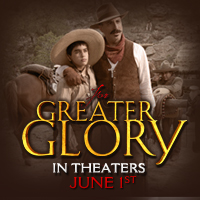
Pre-Order "For Greater Glory"


I've secured mine!

You can get it from Wal Mart or Amazon.  Or go to the movie site HERE for information on all the other viewing options.

For a wonderful review, including an explanation of how the Cristero War was not fought for religious liberty, read Tradition in Action's "A Historic Lesson: The Danger of Compromise".  It includes a link to another article that gives an accurate biography of the young martyr José Sánchez del Río.