Showing posts with label farming. Show all posts

Monday, September 12, 2022

Words to Live By?

Edification. This word chose me last year. Edification and I had a good run with her as my co-pilot while I navigated the rough roads of 2021 with both gloved hands on the wheel. 

We had a conversation going 'most all the time. 

I especially treasure the memory of one of our roadside picnics, complete with a flask of mint tea, elegant chicken salad sandwiches shaped by a tulip cookie cutter, and poetry recitation from Sonnets from the Portuguese in the shade of a moss-laden oak.

Edification is still with me but has moved to the back seat where she reads and occasionally comments on the scenery. 

Yesterday a new word came and claimed me for its companion: propriety. This word leapt out of the page at me as if it were bolded, italicized, and three-dimensional. This does not seem proper behavior for this word--a puzzlement to be sure. At any rate, the reality was that it was just plain type in Wendell Berry's essay, "People, Land, and Community". To quote:

A farm can be too big for a farmer to husband properly or pay proper attention to. Distraction is inimical to correct discipline, and enough time is beyond the reach of anyone who has too much to do. But we must go farther and see that propriety of scale is invariably associated with propriety of another kind: an understanding of and acceptance of the human place in the order of Creation--a proper humility.

Berry is using propriety to mean "the quality or state of being proper or fitting," which is a definition I am eager to explore because it implies a timelessness that we do not get from the understanding of propriety as "the standard of what is socially acceptable in conduct".

Clearly, what is socially acceptable in conduct can and does change dramatically.

"Sad, but so true!" remarks Edification from the back seat, reaching for her dainty but well-worn copy of Famous Shakespeare Quotes.

 This leads me to thinking about limits and right back to the quote above. I don't see how to understand "the quality or state of being proper or fitting" without taking into account the concept of limits.

If I am reading Berry correctly, a proper humility is what helps us recognize the limits.

"Gosh," I sigh to myself, involuntarily squeezing the steering wheel. "Much food for thought in this word." 

"Indubitably," chirps Propriety from the passenger seat.

By the way, in my dictionary, Webster's Third New International Dictionary, copyright 1981, the first three definitions are obsolete usages; the fourth one is the one I want to study; the fifth is the "standard of what is socially acceptable in conduct" one.

Thursday, October 8, 2015

I Dream of Catholic Agrihoods

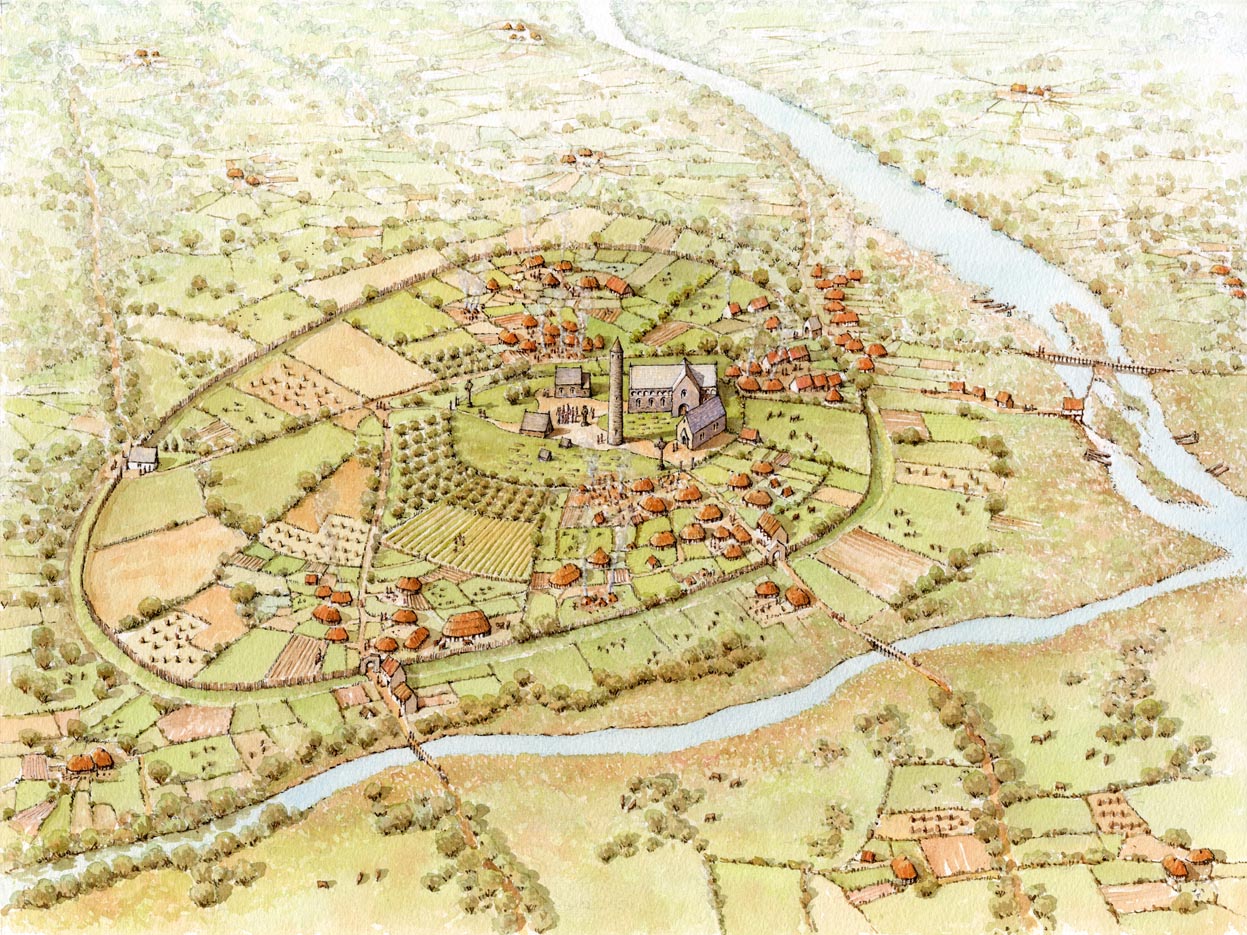
The Early Monastery, Kilkenny, Co Kilkenny


Image ©Cathedral Church of St Canice - Paint the Past


On the way to church on Sunday, my daughter Emma read me an article on agrihoods, an up and coming "thing" where houses are built around a working farm rather than say, a golf course.  The prices quoted in the article for this one in California made me laugh.  I think the median home price was $500,000.

Of course Catholics solved this food/community problem ages ago by building houses around a monastery or cathedral.  This make a whole lot more sense, as you have a Catholic community, real food, and ready access to the sacraments, not to mention the grounding effect of having Christ in the tabernacle physically at the center of your life.  And Catholics could actually afford the houses.  But how do you adapt this model to the conditions in modern America?  At least starting out, it would seem that we would have to build modest homes around our traditional chapels, as there just aren't enough monasteries or cathedrals that have not been taken over by what Anne Catherine Emmerich called "the Dark Church," which I equate with the new religion of Vatican II.

I have even looked at some traditional chapels that already have modest homes on small lots surrounding them, but they weren't occupied by the parishioners.  These neighborhoods would be good places for young couples to start out, especially if they got together and made a plan for purchasing these homes.   Square-foot gardening and edible landscaping would be great options for these situations.

Alternatively, Emma has talked for years about finding acreage and getting her friends together to buy plots of it.  Then everybody could help build off-the-grid houses--she favors Hobbit-like cob houses--and get private and/or community gardens started.  Then they would build a chapel and rectory and find a priest to come and shepherd them.  Or maybe the priest part would be first.  She has even thought about which of her friends would make a good midwife, which a good schoolteacher, etc.  Start small but dream big.

I think these are great ideas, and I hope this post gets more young people thinking about Catholic solutions to living the faith in the midst of the death throes of the Vatican II religion.  I know there are already some groups thinking along these lines; I've seen at least one on Facebook, so Emma and I are not totally whacky in considering these options.

I've been reading Song for Nagasaki to my parents, hoping it would help convert my agnostic dad, a retired electrical engineer, as he identifies strongly with scientists.  There is a lot of discussion in the book about the Japanese Underground Christians and how they kept the faith without priests for a couple of hundred years, I believe.  I can't remember the exact length of time.  I hope we don't have to do that, but it is something that we should prepare for.  At least we have live-stream internet masses and DVD recordings of masses and mp3 recordings of sermons for now.  If you don't have access to a chapel with the true Mass and true Faith as known and practiced until the death of Pope Pius XII, I think you will find help and encouragement in these posts:

Being a Real Catholic While the Church is in Eclipse

What to Do If You Have No Mass


Tuesday, August 13, 2013

On My Florida Vacation

I got to talk to a lady from Switzerland who now lives and farms in Bonifay, FL, and was selling eggs and jams and such at a farmer's market in Seaside, FL.  We talked about organic feed mills!  I was in heaven.  Her chickens free range all day, and she gives them a certified organic feed with NO soy.  That, my friends, is hard to come by.  You can buy certified organic eggs at the grocery store, but most likely the chickens who produce them do not have access to pasture, and their feed is full of soy.  The eggs will have soy protein in them.   A bag of certified organic, soy-free chicken feed costs about $35.  This lady sells a dozen eggs for $7.  I could taste the difference.

I spent the most glorious time playing in the Gulf.  I could not get enough of it.  I learned, via my husband's observations while snorkeling, that sand dollars crawl along the bottom and leave tracks!  For some reason, this little fact charmed me.  I spent many happy moments imagining sand dollars marching  resolutely across the sand, leaving behind their little sand dollar trails before burying themselves for some unknown--to me anyway--endeavor.

I also learned that my modest bathing costume alarms life guards.  I was frolicking along in about knee-deep water, happy and carefree, when a life guard paddled over to me on his surf board, or whatever it is they use.  He greeted me, and I thought, "What a nice young man!".  He asked me where I was from.  I told him and asked him where he was from.  I was thinking, "Now isn't he sweet to come over here and make conversation with me!"

Then, the bombshell.  "Why are you swimming in your clothes?" he asked me.

"I'm not swimming in my clothes.  This is my swimsuit," I explained.

"I always check on people who wear their clothes into the water," he said.

Because I didn't choose to wear undergarments to swim in public, he thought I was crazy? *sigh*  Later, my children laughingly explained it for me.  "Yeah, Mom, he thought you were trying to commit suicide!"  :(


Tuesday, July 16, 2013

Abandoning Our Superstitious Beliefs About Knowledge

I've been on a Wendell Berry thing.  He promotes the agrarian lifestyle in the most eloquent way.  I love to read his essays, but even more I love to listen to him talk!  His voice seems to reflect the calm, thoughtful way in which he lives.  Maybe working so close to the land gives him an inner peace that can then flow out through his vocal chords.

Last week I listened to a Wendell Berry interview from 1981, but it was just as fresh and insightful as if it were recorded this morning.  He has a knack for helping you see something from a totally different perspective, usually things that are so endemic to our American culture that we have accepted them without ever considering any other possibility.

Anyway, in this interview, Berry makes the point that acquiring more information is not necessarily a good thing.  That doesn't seem like such a big deal until you really think about how profoundly it affects the choices that Americans make, whether it's to get a college degree or do a Google search or finance a multi-billion dollar research project with taxpayer money.  We assume that the more information we have, the better off we are.  I have unconsciously subscribed to this philosophy and research subjects endlessly in order to make an "informed decision".

So I was rather shocked when he says that "the evidence is overwhelming that knowledge does not solve the human problem.  It probably doesn't solve anything.  Indeed the evidence suggests, with Genesis, that knowledge IS the problem."  (audience laughs)

At that point, I re-grouped and realized what he meant.  He was differentiating between knowledge and wisdom, that same wisdom that used to be one of the ends of education but has now been discarded in favor of knowing miscellaneous facts and being able to pass tests.  Berry makes that clear right away when he says, "Or perhaps, we should say instead, that all our problems tend to gather under two questions about knowledge: One, having the ability and the desire to know, how and what should we learn?  And the other, having learned, how and for what should we use what we know?"

If only we asked these questions!  The questions presuppose, however, that the questioner shares the same moral code as his countrymen.  That is definitely not the case in America, where atheism is given the same respect as Christianity.  Well, actually, it is given more respect.  Muslims probably get the most respect of all.

He continues, "One thing that we do know, that we dare not forget, is that better solutions than ours have at times been made by people with less information than we have."  This statement I knew immediately to be true from my experience with trying to eat real food.  My great-grandparents definitely knew more about how to nourish themselves than my generation.  And they "learned" from their culture.  It was passed down to them, not something they researched.  For a thorough introduction to this topic, I recommend Nourishing Traditions, a cookbook/primer about traditional ways of eating.

The US government has promoted policies that have destroyed the kind of community that passed down knowledge and wisdom.  Of course the most fundamental community is the family.  We used to be a country full of independent family farms.  And those family farms made up tightly-knit farming communities that also functioned as a means to share and pass down culture.  So without a shared culture, we are dependent on the latest research, devoid of any connection to God, tradition, or any loving consideration of future generations.  Without community, we pave the way for the likes of Monsanto.  And Empty Nest Syndrome.

"We know too, from the study of agriculture," Berry says, "that the same information, tools, and techniques that in one farmer's hands will ruin land, in another's will save and improve it.  This is not a recommendation of ignorance.  To know nothing, after all, is no more possible than to know enough.  I am only proposing that knowledge, like everything else, has its place, and we need urgently now to put it in its place.  I will have something later to say about what I think its place is.

"If we want to know and cannot help knowing, then let us learn as fully and accurately as we decently can, but let us at the same time abandon our superstitious beliefs about knowledge--that it is ever sufficient, that it can of itself solve problems, that it is intrinsically good, that it can be used objectively or disinterestedly.  Let us acknowledge that the objective or disinterested researcher is always on the side that pays best, and let us give up our forlorn pursuit of the informed decision.  The informed decision is as fantastical a creature as a disinterested third party (audience laughs) and the objective observer."

One has only to recall the history of eugenics to know that Berry is absolutely right.  This is why separation of church and state creates catastrophes on a worldwide scale.  We must live an integrated life.  There must be limits.  Our choices in what to learn and how to use what we learn must be informed by the Faith.

Let us restore Christendom and quickly!

P.S.  For me, one of the most interesting things about this talk is how Berry applies these ideas to agriculture and marriage simultaneously.  In Part 2 of the interview, he compares purchasing a farm to getting married, and it is at once illuminating and humorous.  Each part is only about ten minutes long, perfect for a coffee break!


Wednesday, June 12, 2013

When Father's Day Was Every Day

I have long been interested in the ways that the Industrial Revolution affected family life and how our society might facilitate the return of the patriarchal family.   To my way of thinking, if you really want to do this, you not only have to bring mothers home, you have to bring fathers home as well, because home loses its importance when its head spends the best part of his day elsewhere.

About six months ago I discovered an article titled "Industrialization and Marriage" by Robin Phillips. 
Its main premise is that industrialization fundamentally changed marriage, and this paved the way for our modern de-functionalized homes and even the feminist movement.

Phillips writes that "prior to 1800, the vast majority of people lived and worked in the same place.  Whatever else a couple's relationship may have involved, they were quite literally in business together.  The home, in turn, was not a place where people 'lived' as a passive activity when they were not doing other things.  Rather the home was a small factory, a bustling hub of productivity."  This is how the wife felt part of something important, and she could truly fulfill her role as helpmeet.  I know that I feel  peaceful and am much more focused on what I need to do when my husband is home the whole day.

This idea of the husband and wife being in business together prior to the Industrial Revolution made me think of how we now have "bedroom communities", "media rooms".  Keeping rooms were a mainstay of Colonial houses because inhabitants lived and worked in them.  Keeping implies activity, as in keeping house.  

Here's the part of the article that really stopped me and made me think:  "The geographical proximity of home and work had an impact on how couples thought of their relationship to each other.  A man and wife did not think of their relationship as something that could be abstracted from their mundane life together in the world." He explained that marital relations and earning a living "were closely bound together, and both were situated within an ecosystem of obligations, responsibilities, priorities and expectations that were bigger than the couple's relationship.  Because marriage was understood to be bigger than the relationship itself, this helped to anchor marriage in a narrative external to the two participates (sic)."

Of course this "in business together" relationship extended to the children as well.  I am listening to an audio book on rhetoric by Professor Michael Drout.  He says that in Sanskrit, the word for daughter means "one who milks the cow".  The professor says that it is believed that Sanskrit and Greek and Latin sprung from a common language, so you can see how deeply-embedded these home-supporting roles were in our culture before Capitalism came along.

 I was stunned to learn about the role government played in promoting modern housing.  Silly me, I thought people just got tired of farm life and wanted to move to the suburbs, but no, the "Industrialization and Marriage" article reveals that "the concept of the family room originated from guidelines that the government issued in the middle of the 20th century when specifying how homes could qualify for insurance.  A new model of the home emerged which deliberately detached it from labor and functionality.  Government planners urged architects and home-owners to get rid of walls and doors, to eliminate various work rooms like the sewing room and the pantry and to focus the house instead around the type of domestic bonding that was supposed to occur in rooms like the family room."

Gee, this sounds like what happened to architecture in the Catholic Church after Vatican II.  The functionality of divine worship that was expressed by things like altar rails was destroyed in order to promote "community".

In the case of housing, this change was necessary to convert independent producers into dependent consumers of industrial goods.  It has taken a long time to accomplish, but we are there.  State governments implemented compulsory schooling to speed this along.  I imagine that once dad was gone from home, taking the children was a lot easier, especially as classical education was swept aside and replaced with the memorize-and-regurgitate-textbooks method.

Clearly we have been duped into destroying God's plan for the family.  If only we could see it.

Monday, October 10, 2011

The South's Gonna Rise Again With the Help of Tridentine Mass Supporters?

The crown of thorns given to Jefferson Davis by Pope Pius IX is on display at the Confederate Hall Museum in New Orleans.


THE CATHOLIC KNIGHT: The emerging Dixie Independence Movement is now growing rapidly, and appears to be increasingly populated by Catholics, many of whom are taking leadership roles in the movement across the Southland. While it is impossible to calculate actual numbers at this time, reports are coming in to The Catholic Knight about many traditionalist Catholic groups, such as the FSSP and the SSPX, having a large crossover in membership with the League of the South and the Southern National Congress, especially in states that were part of the Old Confederacy (1860 - 1865). This of course is not limited to traditionalist Catholics, as many practical Catholics of all stripes are becoming partial to the movement.  


My jaw dropped when I read the above passage.  Then I finished reading the post and watched the video.   As someone who sees no hope of improvement in the present political "game" of the Republicans vs. the Democrats, I have come to the conclusion that the country must somehow adopt the Social Reign of Christ the King to avoid total ruin.  I couldn't imagine how such a Catholic alternative would come about.  I certainly never dreamed that it might come through the influence of Catholics in The League of the South, although I realized years ago that the Catholic agrarian movement of Fr. Vincent McNabb seemed compatible with the League of the South ideals.

Read The Catholic Knight's entire post and do watch the video also.  The video starts out a little slow.  Be patient.  It's worth your time.

Wednesday, September 2, 2009

First, We Need Access to Healthy Food

"This is a totally unsustainable food system. It's not built to last--it's built on gasoline, it's built on pollution, it's built on exploitation, and it's built on providing food that makes the consumer sick. It's going to bankrupt our health care system. One out of every three Americans has early onset diabetes, one out of every two minority members. You can't talk about reforming a health care system when you're feeding people this kind of food. It's going to be way too costly."

--Food, Inc., Director Robert Kenner, as quoted in the Sept. 2009 Acres USA article, "The Food Revolution Will Be Televised".

Friday, August 21, 2009

Raw Milk Advocate to be Keynote Speaker at San Antonio Farm and Food Conference

Yes! The author of Nourishing Traditions, Sally Fallon, will address the conference on the topic of the economic and health benefits of raw milk.

Here's all the conference information from Farm and Ranch Freedom Alliance

3rd Annual Farm and Food
Leadership Conference


Join an exciting gathering of non-profit leaders, farmers and ranchers,
farmers market organizers, local foods activists, and more!

• Keynote address by Sally Fallon on the Health and Economic
Benefits of Raw Milk
• Food Safety Bills: What’s Happening in Congress?
• Genetically Modified Foods and Their Impact
• National Animal Identification System (NAIS)
• Organic Certification: Making the Choice
• Climate Change and Agriculture

This conference will give you the tools you need to take action to
protect your farm and your food supply! There will be speakers on how
to lobby, creating social networks, and approaching the media.
Full conference: $85. Includes lunch both days, and keynote
One day only: $45. Includes lunch; does not include keynote.

Keynote by Sally Fallon: $15.
Student / under 16 / second member of a couple: one day: $30; both: $60
Add $10 if registering after September 1 and at the door

WHEN: Monday–Tuesday, September 14–15
WHERE: Pearl Brewery in San Antonio, Texas
DETAILS: for full agenda, directions, updates and to register, go to:
farmandranchfreedom.org or call 512-243-9404

GOLD SPONSORS: H-E-B • Coyote Creek Organic Feed Mill • Edible Austin
magazine • Edible Dallas & Fort Worth magazine
Sponsoring Organizations : Farm and Ranch Freedom Alliance •

Tuesday, August 18, 2009

Get Your Grassfed Beef in Southeast Texas

I buy my grassfed beef from a wonderful Christian homeschool family, the Sisks, in Moss Hill, TX. It is fabulous! I talked to Mrs. Sisk this morning, and she says that they will have steers ready this week. The price is $3.25 per pound, hanging weight. This is an incredible value for your food dollar. Call Mrs. Sisk at 936-334-5869 before noon on Friday to reserve yours.

If you are not sure of the benefits of grassfed beef, read this.

Besides being grassfed, the cows are always treated gently and only travel a few miles from their home pasture to the slaughterhouse. Any rambunctious ones are culled. The cows are slaughtered the same day they arrive at Chubby's Packing Company to insure that they are not left in a dry lot. Chubby's takes your custom cutting order and vacuum packs and labels it for you after the meat has aged. They call you when the order is ready to pick up and load it into your coolers. I have been very pleased with their service.

Mrs. Sisk will help put together orders for people who only want a half a cow. Or you can go in together with a friend or family member. That's what my mom and I do.

Wednesday, August 5, 2009

The Benefits of Grass Fed Beef

The results reported below are from the Coyote Creek Farm blog. Coyote Creek raises pastured poultry, grass fed beef, and has the only commercial organic feed mill in the state of Texas. Wabash Antiques and Feed Store in Houston is considering carrying their feed, and that is where I found out about them.

The linked post features helpful guidelines for cooking grassfed beef and then closes with the information below:


In the Grass Farmer’s April 2006 issue, Dr. Tilek Dhiman of Utah State University spoke at the American Grass Fed Association’s seminar and reported:

Some of grass fed’s benefits in comparison with the grain fed products are:

- 500% More CLA
- 400% More Vitamin A
- 300% More Vitamin E
- 75% More Omega-3
- 78% More Beta-Carotene

In grass fed meats studies:

- 11 out of 11 found CLA decreases cancer
- Four out of five have found a decrease in body fat
- Two out of two have found a decrease in heart disease
- Three out of three found a decrease in adult diabetes
- Six out of six have found increased immunity to disease
- Two out of two found an increase in bone density

For information on the nutritional benefits of grass fed poultry, eggs, and dairy products, as well as more information on grass fed beef, read this from EatWild.com.

Wednesday, July 15, 2009

Chipotle Restaurants Sponsor Free Screenings of Food Inc.

Thanks to Hammond Farm for this tip:

In Houston, you can see it tonight, July 15, at the Angelika in downtown Houston, 7:30 p.m. Go to Chipotle's site to see other locations for free admission to the movie that I reviewed here. Avoid the previews if you can.

Saturday, July 4, 2009

A Movie That Could Save Your Life


If you enjoy horror films, you will like the documentary, Food, Inc.

Although I knew much of the information that was covered in the movie from years of reading the alternative press, it is different to know it with your eyes, on a theatre-sized screen. The footage of the poultry houses, the chicken processing plants, the feed lots, and the pig slaughter houses were strong enough to make the point about the perils of factory food without any explanation.

The premise of Food, Inc., is that multi-national fast-food corporations are dictating farm policy. Because they are the biggest purchasers of beef, chicken, potatoes, etc., they exert enormous pressure on the government, which writes the farm bill to cater to their needs. Thus, corn is subsidized to the degree that it sells for less than it costs to produce it. It makes corn so cheap that food producers look for ways to use it in everything. That's why it is hard to buy anything without some form of corn being listed on the label, though you may not recognize it. And of course, the meat producers feed it to their animals. It makes them fat. It also is the main reason that e-coli has become the problem that it is. Cattle are not meant to eat grain. They are designed to flourish on grass. Feeding them grain is what causes most of the new e-coli that has been killing people.

Independent farmer Joel Salatin was interviewed and pointed out how the whole philosophy of factory farming is geared to efficiency and supporting the system that is in place. He said that they never ask "Why?". Because of this flawed philosophy, when confronted with the e-coli problem, instead of feeding the cattle grass, they manufacture a filler for ground beef that is laced with ammonia to kill the e-coli.

The role that subsidized corn plays in our healthcare costs was explored. The consumer is confronted with the contradiction of junk food being cheap, and real food being expensive, all because government subsidies skew the marketplace. The skyrocketing rates of diabetes among the poor are attributed to this.

The movie took on Monsanto and the ramifications of its seed patenting, interviewing farmers who had been sued by the giant chemical corporation. Being able to patent a seed is new. Until Monsanto did this, all seeds were public. The patent means that farmers can not save seed from year to year. Monsanto has been relentless in suing farmers on patent infringement. Even the innocent ones give up, because they can not afford the legal fees.

My biggest disappointment in the movie was that the dairy industry was not covered at all. Food, Inc., would have been the perfect vehicle to get the word out about the dangers of factory dairy products, pasteurization, and homogenization. Again, we have government policy dictating how the food is produced, with disastrous consequences. Maybe there will be a sequel to Food, Inc., that exposes this. Until then, if you do not know the problems, visit the Campaign for Raw Milk page, a project of the Weston A. Price Foundation.

I was also disappointed in the coverage of the new mass-produced organic products. The movie producers missed an opportunity to show how differently some organic foods are made. For instance, organic meat can be grain-fed or grass-fed. The same goes for dairy cows. The grassfed is healthier for you. The movie barely touched on the fact that independent organic food companies are being bought out by multinational corporations. They did not talk about how this affects the product.

Food, Inc., is an important movie. I think it can change lives. Naturally, its greatest impact will be on those who have not done a great deal of reading on the topic. That's why I am so excited about it, because putting the information in a movie format will reach so many people who would never take the time to research it on their own. Go see it. Take your children with you. And eat before you go. You may not want to after the movie.

Thursday, May 8, 2008

Trip to Animal Farm, Part 3

The car made a U-turn, and the bird-watchers came back to the pavilion to tell us that we were about to be rescued from our lonely sojourn.

Within ten minutes we heard voices. A group of about ten people met us at the pavilion. The leader, Mr. Cass Van Woerden, welcomed us and invited us all to follow him back to the learning center. We did.

Seating ourselves in the bamboo chairs or on the large window seat, we listened eagerly as Van Woerden, relaxed and happy, told the Animal Farm story.

The first tour stop was the bathroom hut: a two-toilet facility located between the pavilion and learning center. We didn't go in the bathroom. Instead, Van Woerden lifted the lid of septic tank and invited us to peer into it. I saw not one eager face at this instruction. Instead, the visitors sidled cautiously nearer until they could actually look in and see all the disgusting. . .


leaves, nothing but leaves. The system, explained Van Woerden, consisted of leaves and thousands of worms.There were three more underground reservoirs downhill from the primary tank where the water was filtered. A Montessori class comes on a regular basis to camp on the premises and even under their heavy usage, there has never been a problem with the system.

Next we visited the Van Woerden home. Van Woerden's wife Gita had prepared vegetable wraps, fresh from the garden, and deviled eggs for us.

The house features many sliding glass doors. The outside appears to be inside.. When we were in the learning center, one of the ladies asked about using wool batts for insulation because she had an excess of them. I glanced at Emma, and she gave me the secret eyebrow raise to let me know that she had recognized a fellow fiber nut. She made a beeline for this lady while we were in the house.

We left the house and began the tour of the gardens, all ten acres of them.

Wednesday, April 30, 2008

A Trip to Animal Farm, Part 2

I saw no one and wondered if I had missed a sign. Coming to a fork in the road, I paused, perplexed. Which way?

"Mom?" I heard Emma call. I now knew which way to go--toward my daughter's voice. I took the road more traveled, and that made all the difference. Reunited with her, the wind felt less cold. We studied a flower and waited for Nathaniel.

Soon he appeared, grinning and rubbing his arms. "I'm freezing!" he complained, still rubbing his arms in a futile attempt to free them from the wind's chilling embrace.

"Have y'all seen anyone?" I asked.

"No," they answered together.

We walked three abreast, following our "yellow brick road" and hoping to soon stumble upon "Oz," the Animal Farm Learning Center, where, according to our flyer, we would meet a guide who would take us on an "open house" tour which would reveal to us the secrets of sustainable living.

A faded sign directed us to turn left for the Learning Center. We trudged along, wondering aloud if we would find lots of people there. Just when we had decided that we had missed a turn, we spotted two structures ahead on our left. One elderly couple investigated the site. A Hindu statue protected the entry to the second building, lending it an air of being an ancient ruin. The thatched roof and plastered walls contributed to this feeling. We determined that the second building had to be the Learning Center, since the first was more of a pavilion. We entered the second building.

Woven mats covered the floor of what appeared to be a yoga center. Great expanses of jalousie windows soared to the rafters on one side. Small windows, low to the floor on the opposite side of the jalousied ones, lent a cozy feel. There were no exhibits, no slideshows, just a few bamboo chairs and a built-in window seat. "Maybe this is a Hindu chapel, instead of the Learning Center," I said to Nathaniel and Emma.

Exiting the "chapel", I approached the elderly couple and asked if they knew if we were at the Learning Center and if they knew when anyone would meet us there for the tour. They didn't know any more than we did but seemed content to explore the pavilion and listen to bird calls.

While I visited with the birdwatching couple, Emma discovered a cottage-style flower garden behind the pavilion. Delighted by the number and variety of blooms, she called for me to "come see."


Nathaniel, intrigued, studied the rustic, freeform pavilion walls, which were shaped to fit the tree branch that functioned as the walls' capstone.


It was now after 3:30. We had left home at 7:45 that morning. Feeling suddenly weary, I stepped inside the pavilion and gratefully sat down at a table. "How lovely it would be if someone appeared with a loaded tea cart," I thought. Looking up, the sun shone on us through a peephole in the intricately-designed ceiling. There was no rubber stamping, no "spec" building here.

The sound of a car engine disturbed my reverie, and I looked toward the road to see someone in a white compact car talking to the elderly couple. "How odd that someone would get lost out here," I thought, assuming that they were asking for directions.

PART 3

Tuesday, April 29, 2008

A Trip to Animal Farm

About a mile after the pavement ended and we had crossed a cattle guard, walls of forest enclosed our car. We negotiated a curve only to be met by a turkey, standing sentinel in the middle of the road. We had arrived.

The turkey stepped aside. We proceeded to a small, designated parking area and noted the sign that read: "Go to the Learning Center, 10-minute walk".

An October-like wind, cold and sweet-smelling, whipped into the car when Emma opened the door. It swirled around her, lifting her hair with its energy, waking her from a year-long dream. Urgently, she cast off her shoes, sprang deer-like from the car, and begged to journey now, right now, alone, into the beckoning forest.

"Go," I said, and watched as she rushed away, quickly disappearing around a bend. I stifled the feeling that I might not ever see my daughter again, that this eerie wind, though refreshing, portended no good.

I gathered Emma's shoes and my wallet into a canvas bag and stepped a short distance from the car to wait for Nathaniel to change out of his church clothes. Suddenly, I could wait no longer and called to Nathaniel that I would meet him at the learning center.

"This is like stepping through the Stargate," I mused as I hurried along, pausing every so often to feast my eyes on the endless expanse of green and the myriad flowers that bejeweled the forest edges. And always the wind, the cold, invigorating wind, embraced, then pushed, then pulled me down the dirt road toward the place of rendezvous.

PART 2